St Andrew, Aldringham

www.suffolkchurches.co.uk - a journey through the churches of Suffolk
|
St Andrew, Aldringham |
|
|
||
www.suffolkchurches.co.uk - a journey through the churches of Suffolk |
||


Follow these journeys as they happen on X/twitter.
| Aldringham is one of the ancient
settlements scattered across the heath between Saxmundham
and the coast. The village sits on the main road between
Aldeburgh and Leiston, but the church is a mile off, set
down a track off of the road to Thorpeness, an ancient
manorial site. The little church sits among pines and
broom, with a long row of thirty-four 19th Century
almshouses to the east of it. These are the Ogilvie
homes, and Ogilvie is a name we will come back to.
Externally, at first sight, the church appears entirely
19th Century as well, but in fact that is not the case.
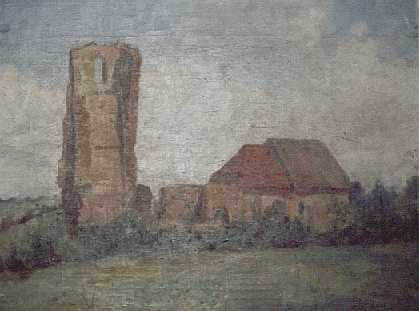
As you'll see from the 1842 painting above, this was a
large church, mostly of the 13th Century, but the tower
and the western two-thirds of the nave were in ruins,
presumably as a result of the collapse of the tower. The
following year, the tower and the ruined part of the nave
were demolished, and a new west end was built with a
bellcote and a Perpendicular-style window. The restored
church is continuous under one roof, with no break
between nave and chancel, but a blocked priest door,
lancet and rood loft stairway buttress survive on the
south side to tell their tale. In the early years of the
21st Century an extension was added on the north side
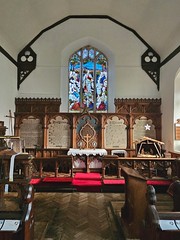
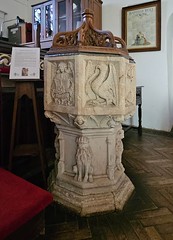
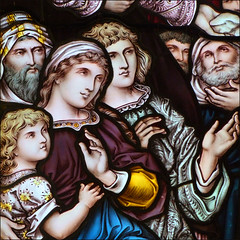
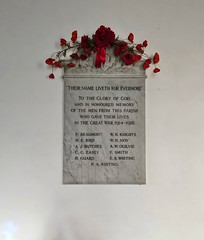
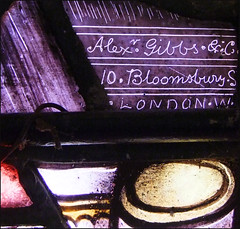
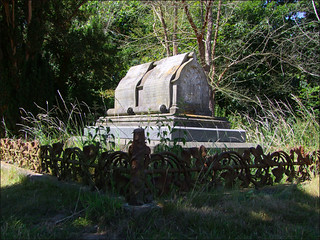
with a vestry, meeting room and kitchen. This is one of those churches which is always open every day, since one of its roles is as a kind of chapel to the almshouses next door. You step into a nave which feels intimate, if perhaps a little crowded. The only survivals of significance from the earlier church are the piscina in the sanctuary and the 15th Century font, which James Bettley thought an uncommonly fine example of the East Anglian type. This style of font, which can be found in over a hundred East Anglian churches, usually depicts the symbols of the Evangelists interspersed with angels, as here, or shields around the bowl. The west end of the church was tiered with benches in the 1870s, presumably for the use of scholars, and the other furnishings in the church were renewed at the same time. It must have been a fairly simple space, but in the late 1890s there was a makeover at the hands of Alexander GIbbs & Co. Theirs are the altar, pulpit and reading desk, but most of all the glass in the east and west windows, dramatically imposing in such a small space. Both windows depict unusual subjects. That in the east window shows the Feeding of the Five Thousand with the barley loaves and fishes. That to the west is more surprising, for Gibbs appears to have tried to cram as many people into it as possible. It depicts the lowering of the palsied man through the roof for him to be healed by Christ. It remembers Caroline Cannon, who died November 8th 1896 aged 81 years, helpless from paralysis 11½ years. A longer version of her story can be found on her splendid Art Nouveau memorial in the churchyard, which has elaborate ironwork surrounding it, presumably from the Garrett foundry at nearby Leiston. The only other coloured glass is the figure of St Andrew which I think may be by Christopher Powell. A simple brass memorial on the south wall of the chancel remembers forty-four year old Benjamin Croft, whose name also appears on the World War I roll opposite. What makes him significant is that he was killed on 10th November 1918, the last full day of the Great War. What an awful piece of luck for him and his family. Another brass plaque remembers Michael Fairfax Hitchcock, who died at Basrah in 1947, which at the time was under British control. He was just 26 years old. Opposite is the memorial to Fergus Menteith Ogilvie of Barcaldine, Argyllshire and Sizewell, Suffolk, who died in 1918. The Ogilvies lived at Sizewell Hall, and quite literally shaped the map of this part of Suffolk. They were responsible for building Thorpeness, the fantasy holiday resort on the coast a mile to the east of here, and the land on which the Sizewell nuclear reactor was built, also a mile away, was also theirs. But best of all, they are thanked every wet Saturday by the divorced and separated fathers of Ipswich, who can let their temporary charges loose in the Ogilvie Room at Ipswich Museum, the biggest public collection of Victorian stuffed birds in the Kingdom. There are simply thousands of the things, including a mighty representation of Bass Rock, and all manner of exotic creatures who met their maker during a flight over the Ogilvies' substantial domain. On more than one display case it says this is the only example of this bird ever collected in Suffolk, and so we may assume that Lord Ogilvie killed an awful lot of birds to make sure that he got these few, a thought which has struck me repeatedly on my many visits to the museum. Ironically, the RSPB's huge Minsmere bird reserve now stretches north of the Ogilvies' former property. Wandering back outside in the churchyard, you'll find the Ogilvie graves to the south of the church, and a long box-hedged avenue leads up to what appears to be the village war memorial, although in fact it is a memorial to one of the Ogilivies, killed late on in the First World War. The inscription mentions Alexander Walter Ogilvie, who died on October 30th 1918, by name, but also makes reference to Lasting Remembrance of the Great Host of Heroes who made the Supreme Sacrifice 1914-1918. The names of the Aldringham dead are hidden away behind it, as if an afterthought. The massed ranks of Ogilvie memorials on either side of it form one of the grandest collections of 20th century family tombs in all Suffolk. |
Simon Knott, January 2024
Follow these journeys as they happen on X/twitter.











|
||||||||||||||||||||||||||||||||||||||||||||||||||||||