| |
|
The poet John Betjeman
once observed in a BBC radio broadcast that his
poems were not intended for clever people.
Rather, he suggested, they were jingles for
those enslaved to their own passions. Some
churches are like that. Mortlock says of St Mary,
Badley, that it seduces the senses, and
sticks like a burr in the memory. Even
Cautley's stiff upper lip wobbled briefly. But to
get to this church, you must find it first. There
are two ways to reach it. No road goes within a
mile of St Mary, and only by a sign to a track
across the fields on the busy Needham Market to
Stowmarket road would you ever know it was there.
The track is drivable, although too potholed to
make cycling a pleasure. It winds lazily through
gentle rises for a mile or so, and the noise of
the modern world is soon lost behind you.
eventually, a cluster of buildings appear below.
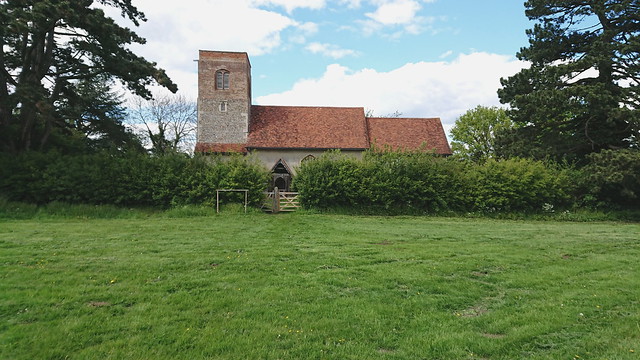
It is a lost valley. You reach the Hall and a
farm house with its and outbuildings, with the
red brick church tower in front of it. That's
all. Beyond, a hazy maze of trees and fields. No
other building is in sight. It is utterly
bewitching. In early spring, the wild fields are
getting their greenness, and lapwings huddle in
the furrows. In this setting, church, Hall and
farm are camouflaged, for the grass, hawthorn and
trees make a secret world amongst them.
Crows and jackdaws wheel above. The grassed path
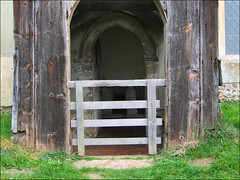
leads to a little wooden porch, with a drop-gate
to keep out animals. As Mortlock observes, it
seems to be original, but there is nothing else
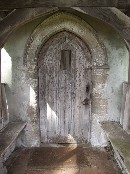
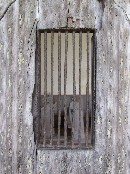
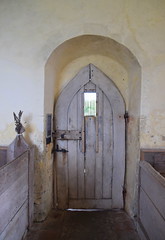
like it in Suffolk. The door into the church has
a metal grill set in it, and this all seems
original too, 18th Century at the latest. Through
this grill, you can peep at remarkable things.
Alternatively, you might come down the long lane
from Combs or Battisford, through Moats Tye and
then take the lonely lane to the oddly-named
Little London. Beyond here the jinking lane
becomes an asphalt track, before petering out
altogether as you approach a farm. There is
nowhere to park, so at this point you'd need to
turn back if you are in a car and seek wonder
elsewhere. Those of us left on foot or a bike
(and you are going to have to push your bike much
of the way from here) will be directed by a sign
through a gate and across a paddock. Beyond a
second gate, a muddy track leads downwards under
bowering trees, and just as you think you must
inevitably end up lost in the woods you come out
into the clearing described above.
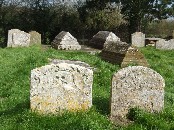
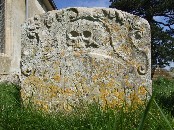
The churchyard is still in use for burials, and
what a peaceful spot this must be in which to see
out eternity! It is pleasant enough to rest here
if for only a moment, especially on a sunny day,
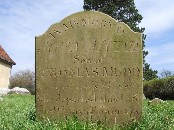
among the scattering of 18th and 19th Century
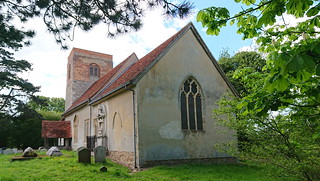
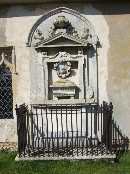
headstones and the large Robins monument set into
the outside of the south chancel wall. The birds
don't seem to mind us being here, although as
with many remote spots it is not always so easy
to be alone here on a Sunday afternoon in summer.
At this point it is worth saying that the church
is usually open at weekends from Easter to
September, but if you are making a special trip
it is really worth checking the CCT website to
make sure there are no planned closures, and
coming from the Needham Market direction, because
a nearby keyholder is listed on a sign at that
end of the track. At the very least, he will be
able to tell you if the church is already open,
and give you the key if it is not.
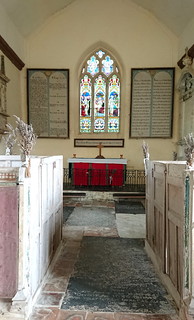
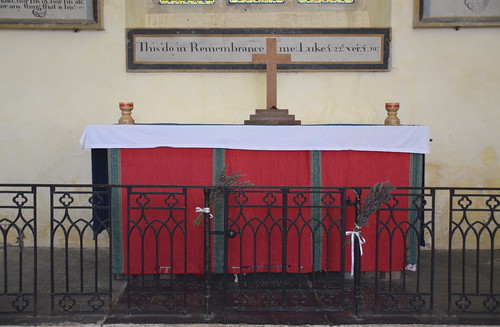
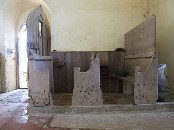
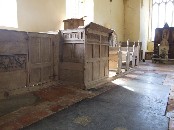
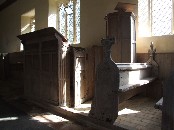
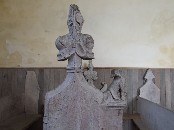
And you will really want to see inside, for
Badley church is haunting and evocative inside.
It is essentially an untouched 18th Century
interior, with barely a sign of Victorian
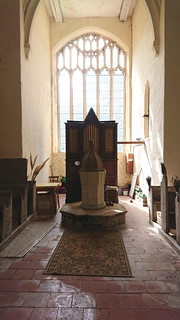
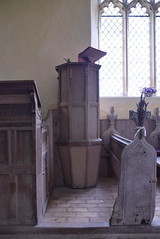
enthusiasm. The benches and box pews are bleached
white by centuries of Suffolk air and sunlight,
and flooded with sunshine by the remarkably large
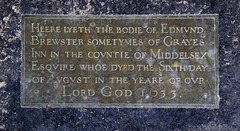
five-light west window. The tiled floor spreads,
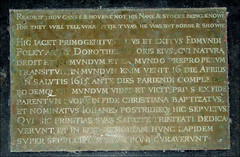
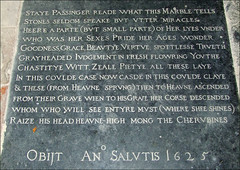
punctuated by ledgerstones and brass
inscriptions, entirely rustic. 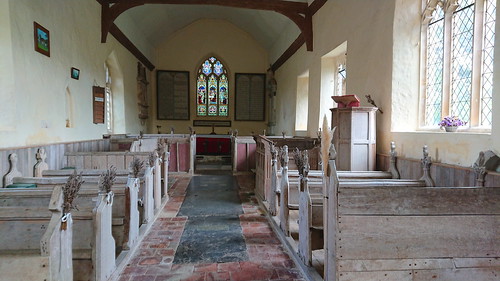 
 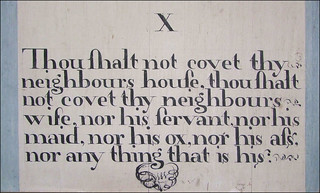 
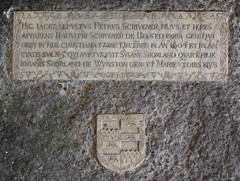
There are
brass inscriptions and memorials to the Poley and
Scrivener families. Perhaps the only jarring note
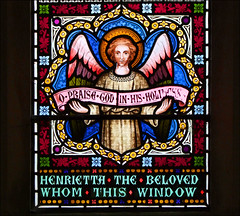
is the unexciting 19th Century glass in the east
window, typical of Frederick Preedy's 1860s work
for the Norwich Diocese. It depicts three
Resurrection scenes, not an inappropriate theme
here, with Thomas placing his hand in the wound
of Christ and Mary Magdalene meeting Christ in
the garden, these two scenes flanking Christ
breaking bread at the supper at Emmaus.
The church
fell out of use in the 1970s, and is now in the
care of the Churches Conservation Trust. But it
hasn't always been loved. The iconoclast William
Dowsing came this way on the morning of Monday,
February 5th 1644. Dowsing had a house nearby at
Baylham, although by this time he was living
further off at Stratford St Mary. It was the last
full day of his first tour of Suffolk, and he was
probably in a bad mood - certainly, he seems to
have been only just realising the enormity of his
task, and this was the week he appointed the
brutish and scheming Thomas Denny as his deputy.
Dowsing found an ally here at Badley in William
Dove, the principal landowner and churchwarden.
Dowsing himself had about half of the stained
glass broken down, but he trusted Dove to get rid
of the rest. He also charged him with the task of
lowering of the chancel steps which had been
raised by order of Archbishop Laud a decade or so
before. No old glass survives, and the chancel
steps were never to be made high again.
Kirby's 1764 Suffolk Traveller found 82
people living in this parish, although many of
these must have been down on the main road, part
of which is within the parish boundaries. In
1844, White's Suffolk Directory showed a
population increase of just one, to 83 - there
were three farms, a windmill, and William Mudd
living in the Hall. You can find memorials to
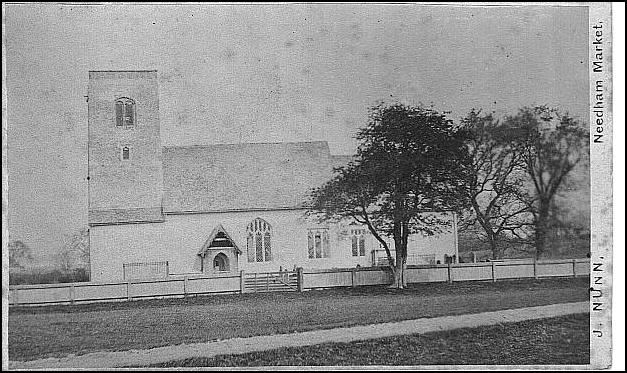
Mudds in the graveyard even today. You can see
what the church looked like in the 19th Century
from the old photograph at the top of the page
lent to the site by Nick Balmer. Today, two farms
remain, although the mill has long gone. Despite
this, and it is a curious thought, out of all
Suffolk's churches the journey here still most
closely resembles that made by both Dowsing and
Kirby.
It is a hard church to drag yourself away from,
but eventually you must do so. If you have come
here by car, you'll need to go back along the
track to Needham Market, but if you are on foot
or on a bike and you came that way, you can
extend your journey into the past by continuing
along the track west from the church. It forks
here, and the right fork leads into the farmyard
of Badley Hall, but the left fork is the public
right of way I described earlier. The muddy track
leads upwards from here, eventually taking you
back to the gated paddock described above (the
first time I came here in the 1990s I didn't
notice this, and got a proper telling-off from
the farmer for going through his farmyard). The
track continues along the top of the ridge, and
if it is winter and the trees are not in leaf
then you can see Badley Hall and the tower of St
Mary in the valley below.
After about
another half a mile, the track becomes metalled
again, and after a hauntingly beautiful little
thatched cottage, the rather mundane bungalows
tell you that you have reached the hamlet of
Little London. The top of Combs church peeps
rather surreally over the crest of a field, and
you can walk to it in ten minutes from here, or
take the long way round by road, about two miles.
A bit further on, you fully rejoin the 21st
Century at the junction with the Stowmarket to
Battisford road, where the busy traffic will give
you cause to wonder, just for a moment, if it was
all a dream.
|
|
|