| |
|
| |
|
Barnardiston is a quiet
little village just off the busy Haverhill to
Bury St Edmunds road. I first saw this church
from miles away when I was wandering about the
graveyard of Little Wratting. As I set off
towards it though, it disappeared; by the time I
had negotiated the industrial empire of the
pig-murderers in the valley, I was reduced to
avoiding the cars that screamed past me on the
busy Haverhill to Bury road. Spotting distant
medieval towers was not an option. Indeed, I
didn't see the church again until I was actually
in the churchyard, so tree-shrouded it is from
the north.
Barnardiston seemed a peaceful place after the
noise of the road, and they must have known I was
coming, because someone had rushed out and stuck
up a notice with no less than five keyholder
phone numbers on it. However, as it was a
Saturday they were all out except for the last
one, whose answer came as something of a relief.
He said he'd be right over, and so I had a quick
look around the outside while I waited for him to
turn up.
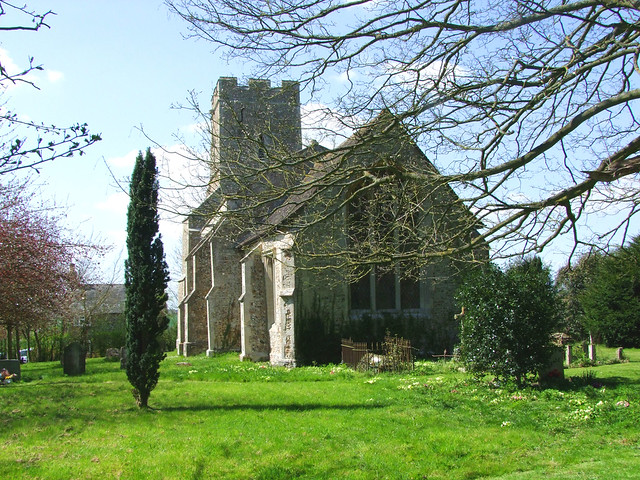
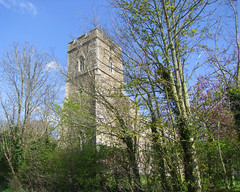
The church stands
on the ridge, and as I suggested earlier
its tower is visible for miles around.
But it is in its last days. The
congregation is barely a handful, and
they leave it locked so that it is of no
value to passing pilgrims and strangers.
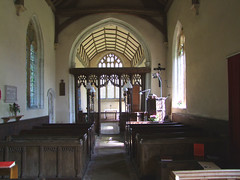
Redundancy beckons. In keeping with the
mood, the interior is sad and dusty, the
few medieval benches being the only
survivors of the considerable 19th
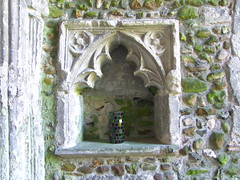
Century restoration. A curiosity is a
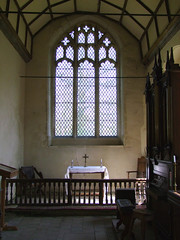
windmill scratched into the sill of the
south chancel window by some bored cleric
in the 17th Century. The post mill, which
could be seen through the window and
which is what he was copying, has long
since disappeared. Until a century ago,
these beautiful structures swung proudly
across the Suffolk landscape. Every
parish had at least one; if our 18th
century ancestors came back today, one of
the first things they would want to know
would be where all the windmills had
gone.
Local tradition has it that Blood
Hill to the south of the church was the
long-forgotten site of Boudicca's last
stand against the Romans, and their final
victory over her. |
|
 |
|
|
|
Simon Knott, July 2015
|
|
|