St Mary, Battisford

www.suffolkchurches.co.uk - a journey through the churches of Suffolk
|
St Mary, Battisford |
|
|
||
www.suffolkchurches.co.uk - a journey through the churches of Suffolk |
||

Follow these journeys as they happen at Last Of England Twitter.
| Battisford sits above the Gipping
Valley, a long village in a long parish. Its church is
right at the eastern end of the village, beside the Hall,
and much of Battisford is closer to the parish churches
of Little Finborough and Ringshall than it is to its own
parish church. However, the old part of the village
around the church is an idyllic setting of cottages and
hedged lanes. I still remember my first visit here, late
one afternoon towards the end of the last summer of the
20th Century. The verges were richly overgrown, the sun
was low in the sky behind me, the hills towards Hitcham
suffused with crimson and gold. It was like being in a
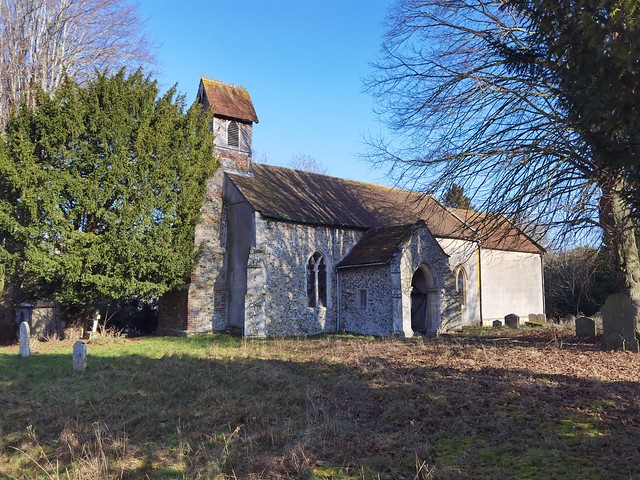
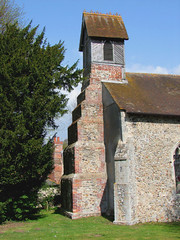
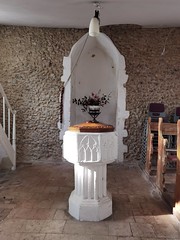
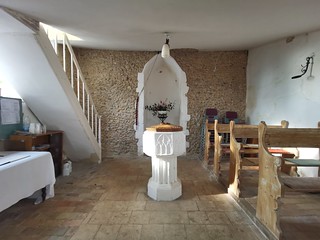
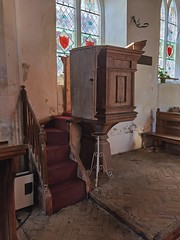
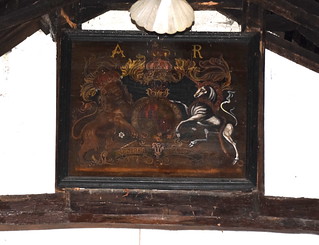
hymn. The church sits in a fairly tight churchyard, mostly maintained as a nature conservation area. It is at first an awkward, even an ungainly structure. The nave and chancel appear all of an early 14th Century piece, but the tower fell, probably in the late 18th Century, and the west wall was repaired soon after in an unusual way. A single wide buttress in the middle of the wall steps in stages up to a little bell gable which was added to the top in 1902. Sam Mortlock thought it looked as if the builder had made it up as he went along, which he probably did. On the south side is the original porch, its uneven step made up of two gargoyles from the tower, which had the fortune to survive its fall. The porch has not been used for many years, and the south door no longer has an opening mechanism. However, despite the unpromising exterior, if you go around to the north door you step into an interior of memorable elegance and charm. This is a church fitted out for traditional Anglican worship, where the Book of Common Prayer must feel entirely at home. The painted gallery is a real period piece, and that it was installed as late as 1841 tells you something about the Low Church tradition here. These galleries were once common, but in general the Victorians were more enthusiastic about removing them rather than installing them. At the back of it is a royal arms lettered for Queen Anne. It can be dated as being after the Act of Union of 1707 and before the Hanoverian rule began in 1714, but oddly the artist has quartered England and Scotland in the first and fourth quarters rather than the more conventional halving. This suggests it is a reuse of the Stuart arms of the earlier part of Anne's reign, a Scottish Rampant Lion being painted over the French Fleur-de-Lys, and vice versa. Below the gallery is an elegant tracery font, probably of the second half of the 14th Century. The former tower arch behind it has been filled in, and the west wall stripped to expose the flintwork, something you might more commonly see outside of East Anglia. This probably happened at the time of a considerable restoration in 1902, and turning east there are more fruits of the early 20th Century, most notably the elegant patterned glass in the windows, again reflecting the Low Church tradition which would have frowned on saints in figurative glass. Also indicative of this tradition are slate decalogue boards behind the altar, recut in a modern style after their discovery behind the old reredos in the 1970s. In front of the sanctuary a small brass inscription outlined within the carpet remembers Mary Everton, who died in 1608 at the age of 103. Her inscription tells us that she died leaving behind her no issue and that this monument was layde at the charge of Peter Preston. Two near-identical monuments of the 1720s flank the east window, one remembering Edward and Mary Salter, and the other John Lewis. The small vestry on the north side of the chancel has been reordered as a simple little chapel, and beside its door a large memorial of 1685 tells us that in the vestry near this place lyeth the body of Walter Rust of Battisford in the County of Suffolk and Lydia his wife. It goes on to recount Rust's fairly humble charitable bequest, for he did by his Last Will and Testament bequeath twenty shillings worth of bread to be given to the poor of the said parish at or in the porch of the said parish church upon every twenty second of July forever. At the time of the 1851 Census of Religious Worship there were nearly five hundred people living in Battisford, which by East Anglian standards made it a fairly large rural parish. Of these, seventy people made their way, along with thirty scholars, to the Sunday morning service on the day of the census. This was about an average proportion in rural Suffolk, and it meant that the parish church was slightly more popular than the congregational chapel a mile or so off at Battisford Tye., which still exists in a rebuilt form. The census return for the parish church was made by the vicar of Battisford, Edward Paske, but he would not have been present at the service. Paske was also rector of Creeting St Peter near Needham Market, where he chose to live and take services. For Battisford he employed a curate. This was the kind of plurality that the 19th Century Church of England would gradually stamp out, and Paske's situation is a good example of how abusive such plurality could be, for he received £400 annually for each of his two incumbencies, this total of £800 being roughly equivalent to £160,000 a year in today's money. Out of this £800 he paid a paltry £40 a year to John Sammons, his curate who did all the work at Battisford. Poor Sammons was also curate at Gipping on the other side of Stowmarket, which brought him £89 a year, and the Master of Needham Market Grammar School for £50 a year. His three jobs brought in a total of £179 annually, roughly equivalent to £36,000 in today's money. The situation at Gipping illustrated an even greater abuse, for the incumbent to whom Sammons acted as curate, one Reverend J R Oakes, was also rector of Tostock, rector of Rattlesden and vicar of Thurston! These four positions brought him four incomes, and although he lived in Tostock rectory he employed poorly paid curates at all four of his churches. Oakes is perhaps reminiscent of the Reverend Dr Vesey Stanhope, rector of Crabtree Canonicorum in the pages of Anthony Trollope's Barchester Towers, who, in the words of his Trollope Society biography, lived for many years in Italy on the salary derived from his neglected duties. Apart from the font there are few memories of Battisford's medieval past. A 1511 bequest made by one John Scott to the painting of Our Lady at Battisford recorded by Simon Cotton may have referred to a wall painting or even to a panel of the roodscreen, but whatever it was, nothing remains. It is hard now to imagine this church as it was before congregational worship became the norm in English parish churches in the 16th Century. But perhaps this doesn't really matter. Battisford church is a delicious example of simplicity and elegance, a building which is clearly loved and cared for, one that sticks in the memory and invites fond revisits. |
Simon Knott, February 2023
Follow these journeys as they happen at Last Of England Twitter.





|
||||||||||||||||||||||||||||||||||||||||||||||||||||||