e-mail: simon@suffolkchurches.co.uk

St Edmund, Bromeswell

  The top street of this village is the horrible road from Woodbridge to Aldeburgh and Orford, but once you get down into the valley it is a surprisingly lovely and peaceful place; very like its near neighbour Ufford, across the river Deben. The church is down a quiet lane, on a mound, suggesting an ancient site. It is dedicated to the patron saint of East Anglia.

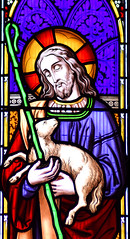
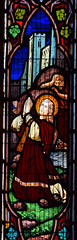
A blank stare from St Edmund, but no offence intended.

  I visited this church on New Years Day 2000, and was pleased to be the first of the new century to sign the visitors book. In fact, this church has few visitors. Possibly because it is hidden from view; and, perhaps, that it has none of the glories of Ufford, or the fascination of nearby Eyke. This is a pity, because it is a rather lovely little church, with some interesting features.

The tower is typically East Anglian 15th century, but not large. The tower was built in the 1450s and 1460s, and has a curious little pyramid on top of it, that may be an 18th century embellishment. The most striking thing as you approach is that there are hardly any windows in the north wall of the nave.

 
  A strange brick course extends upwards from the blocked north door. It is the outside wall of a chimney flue. An unusual modern vestry adjoins the 19th century chancel. Apparently, when it was built, a number of skeletons were found; but, because this is the north side of the church, and those in charge thought them either suicides or the unbaptised, they were reburied without ceremony.

I stepped down into a thoroughly Victorianised interior, and look up at a remarkably steep hammerbeam roof. To fit it into such a narrow nave, it had to be steeply banked, one of the most acute nave roofs I've seen. Quite different to the wide-open spaces of Laxfield and Worlingworth.

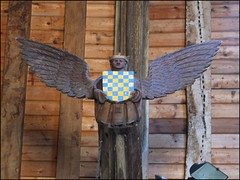
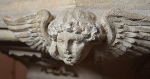
The Reverend Darling's Angel, multiplied elsewhere in fibreglass.

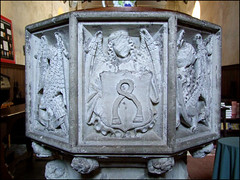
The Victorian skylights at the east end make up for the lack of windows. The angels are mostly fibreglass copies of the two at the far east. These were carved in the 1920s by the carpenter-vicar of Eyke, the Reverend Darling. The story goes that they were originally made for the church at Rendlesham, but turned out to be the wrong scale, so were presented to this church instead. You can see much more of his work in his own church. The angels carry shields, and a key to these is on the wall. The font is also replete with the iconography of power; this time, of church and state.

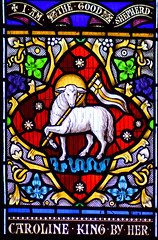
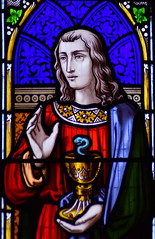
The chancel windows are all memorials to the King family, who provided vicars here throughout the 19th century. There are still modern King graves in the churchyard.

Behind the font, below the tower, there are two curious holes about two metres from the floor, one in the south wall and one in the north. The one in the south has a 12th century head below it; although shallow, it looks as though it might have been a decorated corbel of some kind. The holes are about 15cm square, and go back a long way into the wall. The packing at the far end suggests that they might once have gone through to the outside.

If they were directly opposite each other, you would instantly guess that they had held the two ends of a beam, perhaps supporting a floor. But they are not. Mortlock thought they might have been squints, but it is hard to think this likely.

The greatest treasure of this church was, I presumed, above them. This is the famous Mechlin bell.


A 12th century head below a mysterious hole.

 
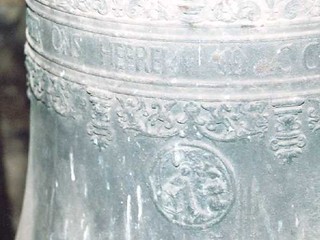
  This bell is decorated with two scenes of rosary mysteries, the Annunciation and the Presentation, as well as the flight into Egypt, and St Michael confronting a dragon. On it, in old Flemish, is written Jesus am I, cast by Cornelis Waghevens in the year of Our Lord 1530. Cautley saw this bell during his 1930s survey, but I could find no mention of it in modern guides.

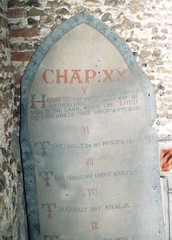
One of the old decalogue boards at Bromeswell, crumpled and stored in the bell-chamber.

  Did it still exist? Had something forced its removal and possible loss during the intervening 70 years?

Fortunately, after I first uplinked this page, two very kind people from St Edmund contacted me, to not only reassure me that the bell still existed, but offering to show it to me.

I was very excited; although I have no head for heights, the inside of church towers always fascinate me. Also, the Mechlin bell is a major medieval art object; I would certainly go and see it if it was in the V&A, so here was a chance not to be missed.

We climbed the winding stair, rather more me-sized than steeper, shallower stairs I've climbed at Rendlesham and Blythburgh, suggesting that they have been renewed since the tower was built. When we reached the floor of the bell chamber, there was another surprise in store. A crumpled length of dusty metal turned out to be, on inspection, an old decalogue board. It was one of a pair, the other now vanished. It is very like the ones on the west wall at Combs.

These boards listed the Ten Commandments, and often the Creed and Our Father as well. They were found at the east end of every Anglican church throughout the 17th, 18th and 19th centuries; some still survive there today. This particular board was an enamelled zinc sheet, commonly found in Suffolk, but more often transferred to the west wall after the influence of the Oxford Movement had encouraged a more sacramental approach to worship. The wooden base of this sheet stands beside it, and was presumably removed from the chancel at the time the King family led a makeover in the 1870s. I was pleased to find it and photograph it.

But on we went, up a narrow ladder, on to the medieval bell-frame. This frame of narrow planks sits about 15 feet above the bell-chamber floor, perhaps 50 feet above ground. I balanced myself precariously on a timber to examine the gorgeous bell. The side I'd climbed features the Annunciation panel, and the end of the inscription, including the date.  

Ons Heeren (The year of Our Lord) 1530. Below, in the Annunciation roundel, an angel (right) appears behind Mary, who has her back to him as at Barnby, and is reading a book.

I'm afraid that my nervousness prevented me climbing across the bell frame to photograph the other side, but what I'd seen delighted me. The bell frame contains two bells, although the tower contains space for a third. There were only two when Cautley saw them in the early 1930s, before they were rehung. The other bell is perhaps 200 years older than the Mechlin bell, but it is, unfortunately, cracked. Cautley deciphered a request for St Paul to pray for us, in Lombardic script.

The Mechlin bell. The roof has been repaired since the birds decorated it.

The other remarkable thing about this place is the pretty churchyard. It contains the largest molehills I have ever seen. An unusual gravestone was pointed out to me. It carries two names, and the people are not related to each other.

The grave of Robert Manby and Mary King.

  The first name is Robert Manby, whose 'premature death' is recorded in June 1823, at the age of 30. The other person is Mary King, who departed this life in December 1822, aged 27 years.

The story is that Mary King knew she was dying of consumption; in fear of bodysnatchers, she pleaded with her lover Robert Manby to watch over her grave, and he did so, sleeping by it every night.

But, eventually, he could no longer bear her absence, and took his boat out into the Deben estuary one Summer's night, and drowned himself there. So, now they lie together, united publicly in death in a way that life could not allow to be so open.

I wondered if the story was a contemporary one, or if generations of passers-by had created the story out of their curiosity. If this is so, then I think that the graverobbers element of the story is an unnecessary prudish, late Victorian invention. Love alone could have been the reason for his lonely vigil, and ultimate self-destruction.

This is a pleasant village for walking, either across the river to Ufford, with its amazing church and wonderful White Lion pub, or to one of the two nearby Bromeswell pubs. Unfortunately, both of these are up on the busy top road. The Cherry Tree is a friendly, family-oriented pub, with good, cheap food. It has an adventure playground out the back for the children. The Wilford Bridge, towards Melton, is said to have some of the best pub food in Suffolk; but if you can afford to eat there, then you are a richer man than me.

St Edmund, Bromeswell, is north of the A1152 Woodbridge to Snape road. It was open when I visited. See MAP

(With many thanks to John and Wendy Colles, without whose help this entry would be much less interesting.)