St Mary, Clopton

www.suffolkchurches.co.uk - a journey through the churches of Suffolk
|
St Mary, Clopton |
|
|
||
www.suffolkchurches.co.uk - a journey through the churches of Suffolk |
||


Follow these journeys as they happen at Last Of England Twitter.
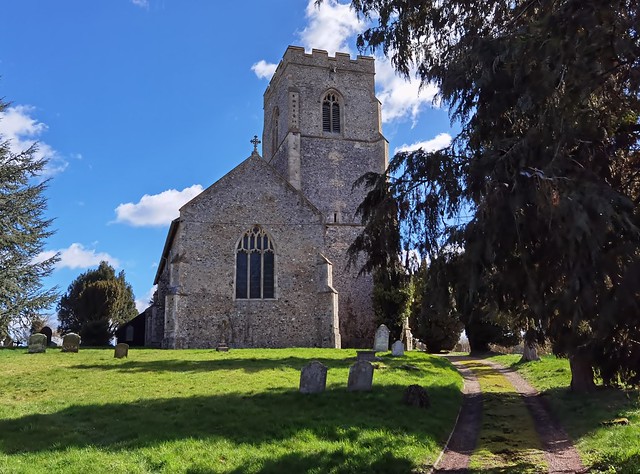
| Clopton church sits in the far
south of its parish above the Woodbridge to Debenham
road, well over a mile from Clopton Green and Clopton
Corner, the two main settlements in the parish.
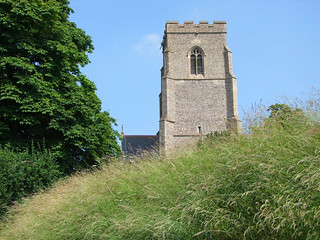
Curiously, it is one of a pair. A few hundred metres
further south sits the parish church of Burgh, equally
remote from its village, and the two buildings have
several other similarities. They are both on mounds, they
both have 14th Century south towers, the naves of both
were rebuilt in the 15th Century with the addition of
angel hammerbeam roofs despite the fact neither has an
aisle or a clerestory. You can't help imagining the
parishes clubbing together over the centuries to obtain
cheaper work as a job lot. St Mary is, however, much the
larger of the two. It is oddly hemmed into the south-east
corner of its sprawling churchyard which falls away to
the north. There were several bequests to the emending
of the chancel during the second half of the 15th
Century, but in any case the chancel was completely
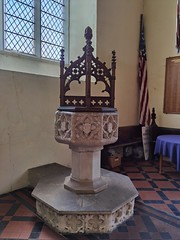
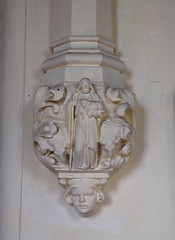
rebuilt by diocesan surveyor Herbert Green in the 1880s. Unlike at neighbouring Burgh church, the porch beneath the tower at Clopton is spacious and open to the elements, and you pass through it to the inner doors and then into a wide interior that is full of light thanks to the lack of coloured glass. The Perpendicular font is set apart below the west window. Cautley thought it a simple late 14th Century font on step with a quatrefoil riser, and yet it presents a curious problem. Peter Northeast and Simon Cotton transcribed a number of wills that relate to Clopton, and two of them concern a font. In 1458 John Lewode left 5 marks, which is to say 31s 8d, a considerable sum, for a font to be newly made in the parish church of the said town, which one might assume would refer to the font here. However, almost three-quarters of a century later in 1532 John Smyth left 13s 4d towards the making of a new font in the same church. The Clopton font has shields in quatrefoils which would have been painted, perhaps with heraldic references to local families. It seems unlikely that John Lewode would have left such a large sum if the church already had such a fine and serviceable font. I suspect that Cautley was wrong, and this is the font from the 1458 bequest. Perhaps seventy-four years later (more than a lifetime really) John Smyth was aiming at something more splendid, perhaps in the newly fashionable Seven Sacrament style, and with a dedicatory inscription that would ensure prayers for his soul. If so, it may be that the Reformation intervened before anything could be done about it. Another possibility is that this font was not originally in Clopton church at all, but was brought here in the 17th Century from elsewhere after an earlier font was removed during the Commonwealth. Looking up, Clopton's hammerbeam roof has been considerably restored, probably in the 1840s if the angels are Henry Ringham's work. It looks as if it might have been similar to the nave roofs a bit further north at Bacton and Cotton. Later in the century Clopton, in contrast to neighbouring Burgh, was clearly in the Low Church tradition, for Henry Green's restoration brought thoroughly biblical chancel arch headstops depicting Christ the Good Shepherd and the Good Samaritan and glass by Ward & Hughes depicting the story of Abraham and Isaac. No popish saints for Clopton. At the time of the 1851 Census of Religious Worship, the population of Clopton was three hundred and ninety. George Taylor the rector was in annual receipt of tithes totalling just under £725, roughly £145,000 a year in today's money. One of the purposes of the census was to judge whether or not rural incumbents were giving value for money (the general consensus at the outcome was that they were not) so it is perhaps not surprising that Taylor failed to answer the question in the return about the size of his congregation on census day. Attendance... was unusually small, he wrote instead, probably on account of weather, and a return of numbers present would only mislead. Just in case someone came back to him and asked what it had been on earlier Sundays, he added no account has been taken for any previous length of time. Taylor had been in post since 1848, and whether or not his response made him a more honourable man than some other rural incumbents who simply refused to fill in the form altogether I leave for you to judge. However, the return was later annotated to reveal that average attendance for Sunday morning worship was just twenty five, bulked out with fifty scholars who had no choice but to be there. Whether or not the size of the congregation really mattered is a moot point (Taylor clearly thought it did) but in his defence there were one hundred and twenty in attendance for the afternoon sermon, for rural mid-19th Century East Anglians mostly preferred a sermon to divine worship. The sad story of Taylor's immediate successor Richard Palmer is played out in the churchyard directly to the east of the chancel, on three headstones. The first is Sacred to the memory of Agatha, daughter of Reverend Richard Frederick and Julia Jane Palmer, 14th February 1873, aged nine weeks. Suffer the little children to come unto me. This little girl must have been born at Christmas, to die on St Valentine's day. Her father, the young rector, must have gone about his liturgical duties with his little daughter's life hanging in the balance. We can imagine the awful winter funeral, the rector burying his own baby. The middle headstone records his own death, six years later. It reads Sacred to the memory of Richard Frederick Palmer, eleven years rector of this parish. Died 8th May 1879 aged 38 years. One wonders what carried him off in the spring, to die so young. And so to the third headstone, which reads Sacred to the memory of Julia Jane, the beloved wife of Richard Frederick Palmer, who died 4th September 1884, aged 45 years. A family tragedy reduced to three inscriptions in a quiet corner of a Suffolk churchyard. |
Simon Knott, March 2023
Follow these journeys as they happen at Last Of England Twitter.







|
||||||||||||||||||||||||||||||||||||||||||||||||||||||