At the sign of the Barking lion...

St Michael, Cookley

At the sign of the Barking lion...

home index e-mail what's new?

www.suffolkchurches.co.uk - a journey through the churches of Suffolk


Cookley: on its last legs?
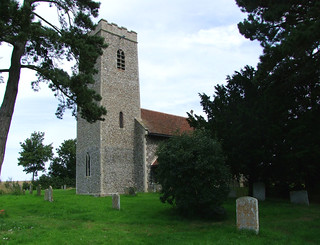
south side north side

In the spring of 2007, I set about revisiting the 650-odd Suffolk churches that I'd previously made acquaintance with at the turn of the Millennium. In general, this was an uplifting experience. For a start, more churches were open than had been almost a decade previously, and some which had been in a poor state then had obviously been well-cared for since. A lot of money seemed to have been spent on our heritage in the early years of the 21st century.

I had been particularly looking forward to revisiting the churches in the Halesworth area. In 1998 and 1999, I had found almost all of them open, almost all of them lovely. I was not to be disappointed, but I did wonder what I would find at Cookley. Back in 1999, this had been the only locked church I had found in the area, and the experience of getting the key had been an odd one.

As in 1999, I set off from Halesworth railway station on my bike, and took the same route through Spexhall, Wissett, Chediston and Linstead. As I say, revisiting was an uplifting experience. And then, I came to Cookley. What would happen there? well, first, here is what I wrote in 1999.

1999: The singular thing about St Michael is that it is in someone's back garden. By which, I do not mean in the grounds of a great hall; rather, it is separated from the village street by several houses, and it is necessary to walk through the garden of one of the houses to reach the church. Something similar exists at Chelsworth and Falkenham, but they, at least, have driveways from the road. Here, you really do have to walk up the garden path, past the washing line and front door, to reach the church gate. This must make weddings and funerals interesting. Of course, St Michael's situation is just a survival of what many villages were like, in the days before public highways and tarmac'ed roads.

Cookley church is locked. And, although a keyholder is listed, the sign makes it perfectly clear that no unaccompanied access will be granted, and the key is only available between the hours of 10-12 and 2-4. You might think from this that the church must be a very interesting church, full of treasure to feast upon. But, of course, that is not so. Only the dullest churches are guarded so tenaciously.

And, beware the clock. I arrived for the key at ten to two, and was quietly made to wait until the appointed hour. That said, the person who showed me around was a lovely man, who obviously adored his village and its church. He told me everything I could need to know, and more. He even offered to remove the fire extinguisher for my photograph, but I told him that I'd rather see everything in situ.

So, what is it like, this Fort Knox in a garden? Well, it simply is one of the worst 19th century restorations in Suffolk. What can they have been thinking of? As late as 1893, this church was effectively gutted, stripped mercilessly of all the accretions of age, including an entire 15th century rood screen. The Stuart pulpit was thrown on a heap, to be rescued by the good people of Chediston, who use it to this day. St Michael was forced into the anonymous strait-jacket of luke-warm ritualism; clinically neat and trim, but very dull. The vicar of the time had formerly been at Flixton St Mary, but found himself here without the money to achieve anything as dramatic, which may explain a lot. It is all a bit awful, I'm afraid.

Of course, I couldn't say as much to my guide. But between us, we did find two things that would make a visit very worthwhile. He showed one to me, and I showed one to him.

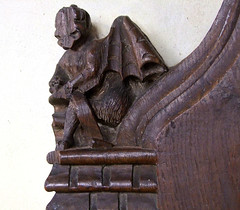
His treasure is not in the main body of the church itself, but through a curtain, in the vestry. Here is the former external north doorway of the original Norman church. It is a delight, and very well-preserved. Not to be missed. It appears militant rather than forlorn between the light-switches and the fire alarm. My treasure was leaning up against the nave wall, just to the south of the chancel arch. It was the main reason I had come here, to see if it still existed (at that time I had not read Mortlock). It is one of the uprights of the medieval roodscreen. I had read in Munro Cautley's 1935 account of his survey of the county's churches how, in his role as diocesan architect, he had identified it built into the structure of a chicken-shed in Huntingfield, a mile or so away. He had it removed, and returned to the church. (One rather likes to imagine the great man red-faced and blustering at reluctant farmhands.)

There is not much to it; more carpentry than art. "We really ought to find a better home for that", said my companion, although it was not clear if he meant back to its original place in the rood screen, or out on the compost heap with the dead flowers. However, as it has been leaning up against this wall for nearly 70 years, I did not fear for its safety. An ancient, typewritten slip of paper telling how it was found was sellotaped to it, but it fell off when I lifted the upright to feel its weight. I pressed the label back on, but it has probably fallen off again by now, and been swept up by some enthusiastic cleaner, I shouldn't wonder. It occured to me later that Cautley had probably typed it himself.

The tower, which is mainly 13th century, is badly in need of repair; they daren't ring the bells now. On leaving, I felt I ought to make a contribution. However, all I could find in my pocket was a 50p piece. "Well, every little helps", I mumbled, putting it on the table, but my guide seemed inordinately grateful, and waved me cheerfully off in the direction of Huntingfield. What a nice man.

2007: In this area of remote villages, Cookley is one of the most remote. It really isn't on the way to anywhere. As I had done eight years previously, I turned off of the Linstead to Huntingfield road along a narrow lane which dipped and doglegged around what must have been ancient field boundaries, the valleys enough to hide any view of the road behind or ahead. But I needn't have worried; as before, I did not pass a single car until I was on the outskirts of Walpole half an hour later.

This is not a grand settlement. Rather, a cluster of small cottages, some of which were obviously former council houses, surrounds the church on its rise. Scotch pines in the graveyard are acolytes to the tower, which appears to have been repaired since I was last here.

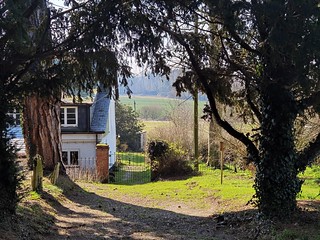
There was no one about. My first striking impression of Cookley was the amount of dog mess on the verge. Living in a town, I am so unused to seeing this kind of thing nowadays, and so it seemed particularly disgusting. Picking my way through it, I opened the cottage garden gate, and walked up to the churchyard. As I passed the cottage, a slavering alsatian barked threateningly at me through a glass door.

Well, the church was locked. And this time, there wasn't even a keyholder notice. What there was instead made the heart sink, because behind the padlocked outer doors I could see a noticeboard, and on it was a large, pompous sign informing me that Cookley is a Forward in Faith church.

Forward in Faith has increasingly become a problem for the intrepid church explorer. The organisation was formed in the 1990s by a bunch of ultra-traditional Anglicans from both wings of the Church, in an attempt to reclaim ownership of the Church of England after the decision to ordain women as Priests. Churches which subscribe to it place themselves outside the authority of their Diocesan Bishop, seeking instead 'alternative episcopal oversight' from one of the so-called Flying Bishops. Not only do Forward in Faith churches not allow women priests to celebrate the Eucharist, they also do not allow male priests who have previously celebrated the Eucharist with a female Priest.

Increasingly over the last few years, I had found Forward in Faith churches locked. It was as if they had decided, as part of their project to repossess the Church of England, to lock us all out of their churches. As a Catholic myself, I find their antediluvian attitudes offensive. It is as if they have deliberately chosen a path to self-destruction. In the background of the photograph below, you can see the Yellow Forward in Faith proclamation - click it, and view large to read it. I don't know what they think they are doing with the cross in the leaflet above, but I know what the padlock in the foreground means.

I decided to go and try the cottage where I had got the key before. This was down on the village street, a few doors up. Picking my way carefully along the verge, I found the kind old man who had shown me around in 1999. He was just getting out of his car. When I asked about a key, he shook his head thoughtfully. It seemed that his wife had now retired as the churchwarden. He really had no idea where a key might be now. "we had the key for years, you know", he said sadly, as if this might help.

I went back up to the churchyard to get my bike. The whole graveyard was full of the smell of chip fat from one of the adjacent houses. I thought about knocking on the cottage door as I passed back through the garden, but the large, salivating dog threw itself at the glass as I approached, as if daring me to do so. And so I didn't. If the key had been there, then I'm sure there would have been a notice, or that the nice man would have known. And if the key was there, then I clearly wasn't welcome to it.

Instead, I got back on my bike, and thought sadly that, if I came back this way in another eight years, it was quite likely that I would find the church no longer in use. If this turns out to be the case, then I have some idea who I will blame.

Simon Knott, 2007

POSTSCRIPT: In March 2008, I received the following e-mail, from a former resident of Cookley who must remain anonymous.

He writes: Hi Simon, we read with great sadness your very perceptive article about Cookley church. We used to live in Cookley. Perhaps you realised how accurately you described the decline of a village, and not just a church, caused in no small part by the influx of arrogant, wealthy people, who care for no-one but themselves. These people think that they are living the “rural dream”, but in fact many of them are destroying what they pay so much to experience. The woman with her “slavering alsatian” is a particularly extreme and unpleasant example of this. She has managed after only a few years in residence, to single-handedly intimidate people to such a degree, that the right of way through her garden up to the church, previously in use for hundreds of years, is now rarely used by visitors to the church. The elderly gentleman you mention,and his wife, genuinely care about the church, but sadly they are in the minority. For too many people in the area the church has become just a social club for the well-to- do. Unfortunately, it seems very unlikely that Cookley is the only village to suffer in such a way.

Well. I am quite happy to publish a response from anyone living in Cookley now who disagrees.


Forward in Faith


Amazon commission helps cover the running costs of this site