St Mary, Flowton

www.suffolkchurches.co.uk - a journey through the churches of Suffolk
|
St Mary, Flowton |
|
|
||
www.suffolkchurches.co.uk - a journey through the churches of Suffolk |
||






Follow these journeys as they happen at Last Of England Twitter.
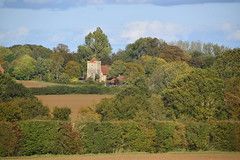
The landscape to the west of Ipswich rises to hills above the gentle valley of what will become the Belstead Brook before it empties itself into the River Orwell. The large villages of Somersham and Offton nestle below, but in the lonely lanes above are small, isolated settlements, and Flowton is one of them. I often cycle out this way from Ipswich through busy Bramford and then leave the modern world behind at Little Blakenham, up towards Nettlestead on a narrow and steep lane, down into Somersham and back up the other side to Flowton. It is unusual to pass a vehicle, or even see another human being, except in the valley bottom. In summer the only sound is of birdsong, the hedgerows alive in the deep heat. In winter the fields are dead, the crows in possession. A hundred years ago
these lanes were full of people, for in those days the
villagers were enslaved to the land. But a farm that
might support fifty workers then needs barely two now,
and the countryside has emptied, villages reduced to half
their size. Most of rural Suffolk is quieter now than at
any time since before the Saxons arrived, and nature is
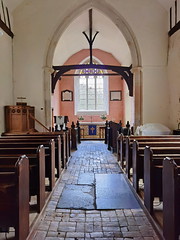
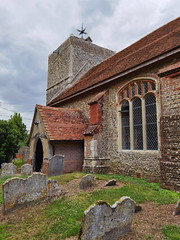
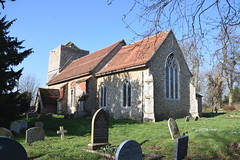
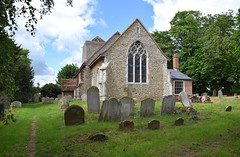
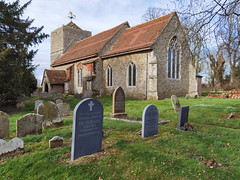
returning to it. But today it would be hard to arrive in Flowton in spring today and not be pleased to be there. By May, the trees in the hedgerows gather, and the early leaves send shadows dappling across the lane, for of course the roads have changed here since Darby and Davy came this way, but perhaps Flowton church hasn't much. James Bettley, revising the Buildings of England volumes for Suffolk, observed that it is a church with individuality in various details, which is about right. Much of what we see is of the early 14th Century, but there was money being spent here right on the eve of the Reformation. Peter Northeast and Simon Cotton transcribed a bequest of 1510 which pleasingly tells us the medieval dedication of the church, for Alice Plome asked that my body to be buried in the churchyard of the nativitie of our lady in fflowton. The same year, John Rever left a noble to painting the candlebeam, which is to say the roodscreen. This is interesting because, as James Bettley points out, the large early 16th Century window on the south side of the nave was clearly intended to light the rood, and so was probably part of the same campaign. The screen has not survived. In 1526 John Rever (perhaps the son of the earlier man of the same name) left two nobles toward the making of a new rouff in the said church of ffloweton. The idiosyncratic tower top came in the 18th Century, and the weather vane with its elephants is of the early 21st Century, remembering a travelling circus that used to overwinter in the fields nearby. The west face of the tower still has its niches, which once contained the images of the saints who watched over the travellers passing by. Another thing curious about the tower is that it has no west doorway. Instead, the doorway is set into the south side of the tower. There must be a reason for this, for it exists nowhere else in Suffolk. Perhaps there was once another building to the west of the tower. Several churches in this area have towers to the south of their naves, and the entrance through a south doorway into a porch formed beneath the tower, but it is hard to see how that could have been the intention here. The Victorians were
kind to Flowton church. It has a delicious atmosphere,
that of an archetypal English country church. The narrow
green sleeve of the graveyard enfolds it, leading
eastwards to a moat-like ditch. The south porch is
simple, and you step through it into a sweetly ancient
space. The brick floor is uneven but lovely, lending an
organic quality to the font, a Purbeck marble survival of
the late 13th Century which seems to grow out of it. The
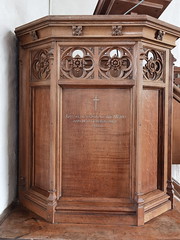
bricks spread eastwards, past Munro Cautley's pulpit of
the 1920s, and up beyond the chancel arch into the
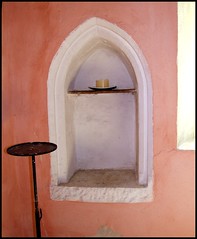
chancel itself. On the south side of the sanctuary the
piscina that formerly served the altar here still retains
its original wooden credence shelf. On the opposite wall
is a corbel of what is perhaps a green man, or merely a
madly grinning devil.
At first sight it
might seem odd that his son could have been born in April
1644 if William senior had died in March 1643, but in
those days of course the New Year was counted not from
January 1st, but from March 25th, a quarter day usually
referred to as Lady Day, in an echoing memory of the
pre-Reformation Feast of the Annunciation. So William
Boggas died one month before his son was born, not
thirteen. It would be nice to think that William Junior
would have led a similarly exciting and possibly even
longer life than his father. But this was not to be, for
he died at the age of just two years old in 1645. As he
was given his father's name, we may assume that he was
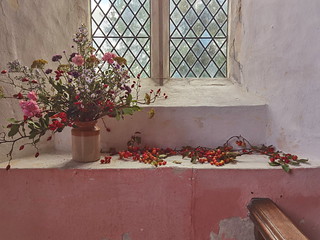
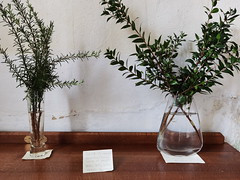
his father's first and only son. Dowsing had arrived here in the late afternoon on what was probably a fine summer's day, since the travelling was so easy. I imagined the graveyard that day, full of dense greenery. He came on horseback, and he was not alone.With him came, as an assistant, a man called Jacob Caley. Caley, a Portman of Ipswich, was well-known to the people of Flowton. He was the government's official collector of taxes for this part of Suffolk. Probably, he was not a popular man. What the villagers couldn't know was that Caley was actually hiding away a goodly proportion of the money he collected. In 1662, two years after the Commonwealth ended, he was found guilty of the theft of three thousand pounds, about a million pounds in today's money. He had collected one hundred and eighteen pounds of this from the people of Flowton alone, and the late John Blatchly writing in Trevor Cooper's edition of the Dowsing Journals thought that the amount he was found guilty of stealing was probably understated, although of course we will never know. I revisit this church every few months, and it always feels welcoming and well cared for, with fresh flowers on display, tidy ranks of books for sale, and a feeling that there is always someone popping in, every day. The signs by the lychgate say Welcome to Flowton Church, and on my most recent visit in November 2021 a car stopped behind me while I was taking a photograph of the elephants at the top of the tower. "Do go inside, the church is open", the driver urged cheerily, "we've even got a toilet!" As with Nettlestead across the valley, the church tried to stay open throughout the Church of England's Covid panic of 2020 and 2021, whatever much of the rest of the Church might have been doing. And there was no absurd cordoning off of areas or imposition of the one-way systems beloved by busybodies in many other English churches. Instead, a simple reminder to ask you to be careful, and when I came this way in the late summer of 2020 there were, at the back of the church, tall vases of rosemary, myrtle, thyme and other fragrant herbs. Beside them was a notice, which read Covid-19 causes anosmia (losing sense of smell). Here are some herbs to smell! which I thought was not only useful and instructive, but rather lovely. Simon Knott, November 2021 Follow these journeys as they happen at Last Of England Twitter.
|
||||||||||||||||||||||||||||||||||||||||||||||||||||||||||||||||||||||||||