| |
|
Fornham St Martin parish
has been largely subsumed into north Bury St
Edmunds suburbia, but the church sits in the old
village centre, half a mile away across the
fields with the village pub and a few old houses
for company, the Bury to Brandon road forced to
slow down and behave itself for a few moments.
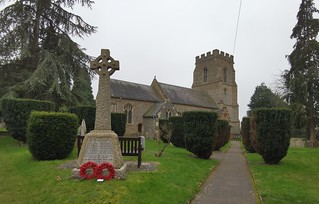
The church sits end on in a relatively narrow
churchyard. Geoffrey Bressele, early 15th Century
rector here, must have been a fairly wealthy
fellow, for he left a remarkable twenty marks in
his will of 1425 to the tower of Fornham,
the result being what we see today. The church
must be broadly contemporary, or perhaps a little
later given the conservative nature of the East
Anglian masons. Externally
the shape of the church is striking, for the plan
is made square by a wide 1870s south aisle as
large as the nave, under its own roof. It was the
work of Sir Arthur Blomfield, who was busy at
work on the nearby Culford estate at this time,
and it replaced an earlier aisle, although it
seems unlikely that it was as large as the new
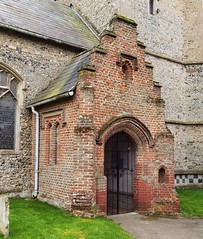
one. The north side of the nave points a
delicious early 16th Century red brick porch
towards an avenue of yew trees which leads
diagonally towards the street. There is an image
niche set deeply into its western buttress which
seems likely to have been designed to hold an
image of the Blessed Virgin, the niche above the
entrance being reserved for the church's patron
saint. Within the porch, the south doorway looks
to be contemporary with it, and perhaps even the
door is too.
Fornham St Martin church is
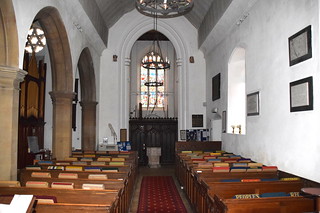
open every day, and the church you step into can
be dark on a dull day. Every window except one is
filled with a half a century's range of stolid
19th Century glass from a variety of major
workshops. The exception is that on the north
side of the nave nearest the door, for this is
the 1970s work of Robert Ashmead for Abbott &
Co. It illustrates the Benedicite, the canticle
traditionally sung in Anglican churches during
Lent:. O all ye Works of the Lord, bless ye
the Lord: praise him, and magnify him for ever. O
ye Angels of the Lord, bless ye the Lord: praise
him, and magnify him for ever.
  
The earliest glass here
dates from well before Blomfield's 1874
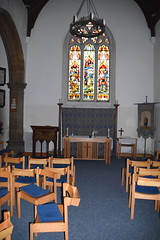
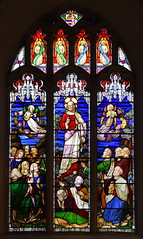
restoration. The east window in the curiously
narrow chancel is by WIlliam Wailes and depicts
the Ascension. It was installed in 1846, and if
you look carefully you can just make out Wailes's
signature peeping above the inscription in the
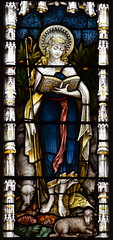
middle light. The best glass in the chancel is on
the north side, St Genevieve and St Elizabeth of
Hungary, I think by Heaton, Butler & Bayne.
Incidentally, you may be wondering about the
Fornham St Martin and St Genevieve banner in the
south aisle. Fornham St Genevieve was an adjacent
parish, but the church there fell into ruin in
the 18th Century and after the reform acts of the
1830s the civil parishes were joined, although
the living of Fornham St Genevieve was joined
with that of nearby Risby. The glass in the south
aisle is mostly by Wailes & Strang, the
Newcastle firm that grew out of William Wailes's
workshop. The window on the north side of the
nave depicting the women at the empty tomb is by
Clayton & Bell, I think.
There are a couple of
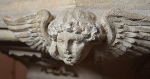
curiosities. Two 15th Century misericords have
been built into the lectern and reading desk. One
depicts the martyrdom of St Thomas of Canterbury,
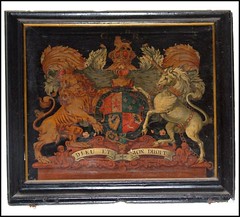
the other St Martin himself. Up in the chancel
there is an imposing 1840s hatchment depicting
the arms of the Duke of Norfolk. Most of the
memorials are on the north wall of the nave. One
remembers Vice Admiral James William
Rivett-Carnac, winner of the Legion D'Honneur
and the Croix de Guerre, who was a man greatly
loved. Nearby, Henry William Claughton was HM
Inspector of Schools in this county for 38 years.
When he died in 1924, his memorial was erected
to the memory of an unselfish sportsman, by his
wife and hunting and cricketing friends.
|
|
|