| |
|
Follow these journeys as they happen at Last Of England
Twitter.
Friston is a medium-sized village out in the
rolling fields beyond Saxmundham and Leiston which seems
to have an air of quiet self-sufficiency about it. In
2010 I had been here on the hottest day of the year so
far, nearing the end of a meandering bicycle tour of the
north and east of Suffolk. The train at Saxmundham was an
hour off, but I headed south again, from the Saxmundham
to Leiston road, under the vast chain of power lines that
links the Sizewell nuclear power station with the rest of
the country. I recalled vividly coming this way back at
the start of the century, on that occasion a darkening
afternoon in late November. I had cut a swathe along
roads which ran like streams. All around was water, after
the wettest autumn for 250 years. The power lines sizzled
and cracked as I threaded through the pylons and beneath
them, the sound of 10,000 quintillion volts of
nuclear-generated electricity urgently seeking the
shortest possible path to the ground. This concentrated
my mind somewhat, as you may imagine.
And now it was 2019 I was here in spring, the trees coming
into leaf like something almost being said, and it
took me a moment to recognise the lane up to the church,
in its huddle of houses with the curiously urban hall
opposite.
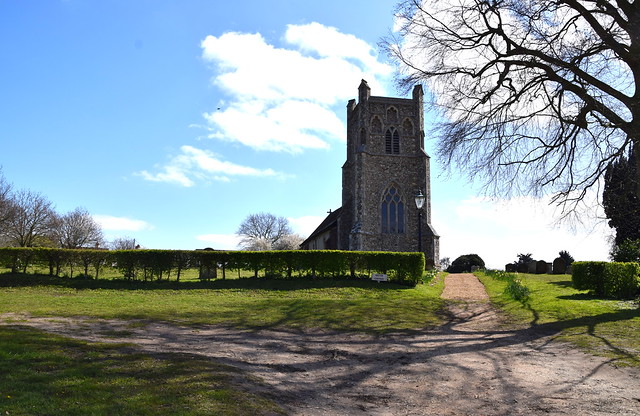
It must be said that the tower of St Mary is rather
striking. The tower seems to be a Victorian rebuild, and
quite a late one. Mortlock generously considers that it
is an exact copy of what was there before. In all
honestly, I would find this doubtful, if it were not for
the fact that the architect was Edward Bishopp, a man not
best remembered for his creative imagination. The most
striking features are the niches, one in each buttress,
and a possible rood group above the west window. This is
a bit like the same at Parham and Cotton, and the
buttresses like those at Wetheringsett, so they may be
original, or perhaps just based on those other churches.
The body of the church must be Norman originally, judging
by the blocked north door, but there are so many late
Perpendicular windows, I wonder if it wasn't entirely
rebuilt retaining the doorway sometime in the early 16th
century.
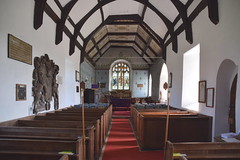
As with all the churches around here St Mary is open
daily, an evocative and intimate space which you step
down into to be confronted by the Parish of Friston's
most famous possession. This is the massive James I coat
of arms. It is fully eight feet wide and six feet high,
carved from boards six inches thick. The story goes that
it was found in pieces in the belfry by Munro Cautley
during his trawl of Suffolk churches in the 1930s. In his
capacity as Diocesan architect, he insisted that the
churchwardens repair it, and restore it to its rightful
place. However, since the chancel tympanum where it had
hung had been removed by the Victorians, this presented
the churchwardens with an interesting problem. So, they
solved it by attaching the arms to the north wall of the
nave, level with the tops of the pews, where it remains.
it is not in great condition, but it is rather
extraordinary to be able to see it at such close
quarters.
The nave is long and narrow, under an arch-braced roof.
The 19th century font stands on an upturned medieval one
as its pedestal, with a rather good early 20th century
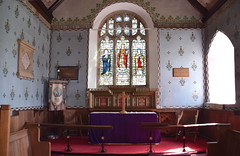
font cover. At the other end of the church is something
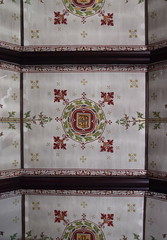
rather remarkable, an unspoiled late Victorian chancel.
So many of these have been whitewashed in the last fifty
years or so, but this is utterly charming, the walls
painted and stencilled in pastel shades, and an ornate
text running around the top of the walls. The finishing
touch is Powell & Son's lush Risen Christ flanked by
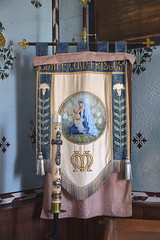
Mary and John in the east window. Another nice detail is
the Mothers Union banner. Thousands of these were
embroidered from kit form in the early 20th Century, but
as at neighbouring Knodishall the one here has been
customised with a hand-painted central image of the
Blessed Virgin and child.
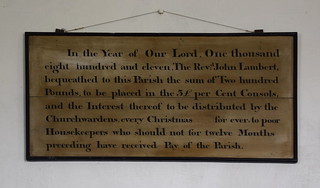
A memorial board reminds the parishioners of Friston that
In the Year of Our Lord one thousand eight hundred
and eleven, the Reverend John Lambert bequeathed to the
parish the sum of two hundred pounds, to be placed in the
3£ per cent consols, and the interest thereof to be
distributed by the churchwardens every Christmas ___ for
ever: to poor Housekeepers who should not for twelve
months preceding have received Pay of the Parish.
The missing word must be Day or Eve,
but it has been eradicated at some point, perhaps for
legal technical reasons, possibly because of the
difficulty of getting to the bank in Saxmundham on a
public holiday.
Two hundred pounds was a fairly large amount of money in
1811, roughly equivalent to forty thousand pounds today,
and for ever must have seemed an enticing
prospect. However, consols were effectively bonds, their
value remaining the same but offering a guaranteed return
(in this case three per cent) based on the perceived
annual growth in the economy. Like endowment mortgages,
they would turn out to be a fairly short-sighted
enthusiasm. The safe return from consols came to an end
as a result of the great depression of the 1870s and
1880s, and inflation thereafter reduced such holdings to
almost nothing. The Reverend Lambert would have been
better off investing in land or gold, but such is the
gift of hindsight, of course.
Simon Knott, May 2019
Follow these journeys as they happen at Last Of England
Twitter.
|
|
|