| |
|
 |
|
Here we are in busy west
Ipswich. Ipswich can feel like a town of two
parts - the docks and the wide river split the
southern half of the town, and the great
Christchurch Park cuts in from the northern
suburbs right into the town centre. Older
townsfolk often identify themselves as either
from East or West, and it was unusual
historically for people to move from one side to
the other. The west side of town is poorer, with
acres of 19th Century terraces, and the more
recent additions of the challenging Whitton and
Whitehouse estates. Suffolk
doesn't have many 19th century churches - or, at
least, not many that aren't rebuilds of medieval
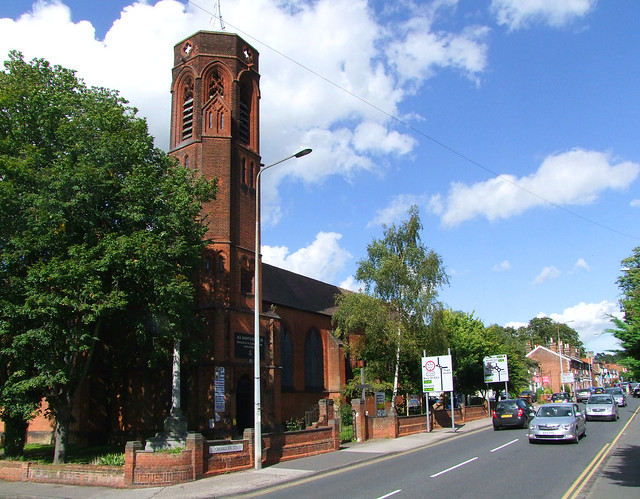
ones. All Saints, then, is something quite
unusual for Suffolk, not least because its red
brick style is most un-East Anglian, a
consequence of the architect being Samuel Wright
of Lancashire, who won the 1883 competition.
Perhaps he put in a speculatively high bid, and
was surprised to get the job. Still, the
octagonal tower is vaguely suggestive of Suffolk
round ones, and in any case it would be dull if
all churches were the same, especially 19th
Century ones. The parish was carved out of St
Matthew, closer into town.
All Saints sits on Chevallier Street, a
bottleneck on the Ipswich ring road, and so many
drivers every day get to have a really good look
at this church. There is a successful mixture of
styles, the Decorated details of the tower
providing the star of the show, and the
Perpendicular aisle windows with their great
arches are also not unpleasing, although perhaps
odd in that their 'wall of glass' 15th Century
style is contradicted by the rather forbidding
and severe red brick expanse and high roof. The
great east (Dec-style) and west (Perp-style)
windows are rather more successful.
|
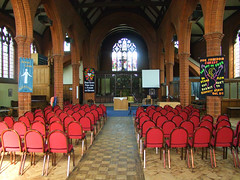
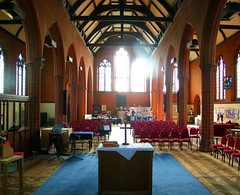
Stepping inside, the view eastwards
through the brick arcades and plain windows of the nave
is impressive. All materials, so it is claimed, were
produced in the parish. Here we are seeing the language
of Early English fluting, for the pillars of the arcades
seem impossibly slight to support the great weight above
us. In fact, it is a cunning trick, for the arcade is
actually constructed of cast iron pillars concealed by
brick dressing. It is all very well done. There is a
sense of emptiness in the nave which contrasts excitingly
with the mystical gloom of the chancel beyond the rood
screen.
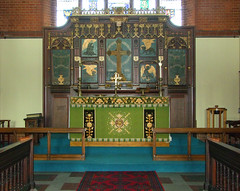
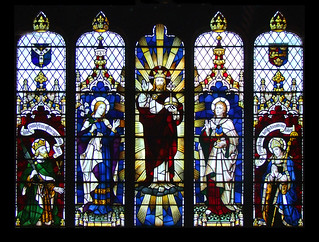
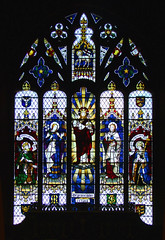
| The sanctuary is full of
serious colour. This building was designed for
Tractarian incense-led worship. The five-light
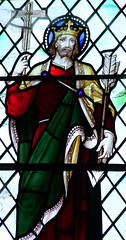
east window of Christ in Majesty flanked by St
Edmund, the Blessed Virgin, St John and St Felix
is credited by Pevsner's revising editor to
'Campbell of London', but it is certainly the
work of Horace Nicholson (thank you to Aidan
McRae Thomson for pointing this out to me).
Whoever Campbell may have been, perhaps Nicholson
was working for him. The window dates from 1938,
and is in fact the earliest glass here. Perhaps
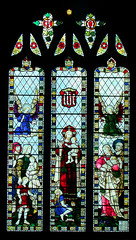
the windows were clear before this. The other two
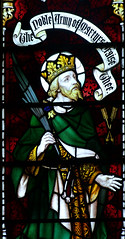
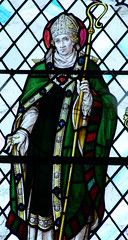
windows are both in the north aisle. That at the
east end of 1950,depicting St Edmund and St
Felix, is by Horace Nicholson's son, AK
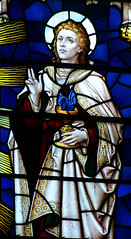
Nicholson. The window at the west end, of 1943,
depicts Christ and the children, and is by far
the best window in the church. Its artist is
unrecorded, but perhaps it is also by AK
Nicholson. When the
church opened in 1884, a young clergyman from a
small village in Kent was appointed as its first
minister, a 'curate-in-charge'. His name was
Richard Munro Cautley, and his young son Henry
would grow up to not only be diocesan architect,
but the greatest historian of East Anglia's
churches. He designed three Ipswich churches, St
Augustine, All Hallows and St Andrew, as well as
other Ipswich buildings including Ipswich County
Library, and the Walk shopping precinct which he
designed with his partner Leslie Barefoot. The
young Cautley learned the aesthetics and
principles of High Anglican worship, and these
infuse just about everything he ever built. He
was only ever at home in the idiom of the late
Middle Ages, and it is a tribute to the work of
Samuel Wright of Lancashire that Cautley learned
it first here.
|
|
 |
|
|
|