| |
|
 |
|
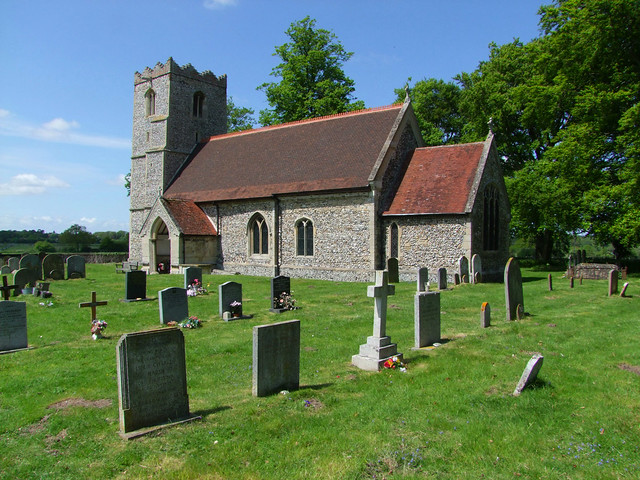
There are few lovelier
settings for a church in Suffolk than
that of St Lawrence. It sits on a bluff
overlooking the Lark Valley, and the
distance from the nearest road means that
all you hear are the birds, the
occasional horse cropping and snorting in
the adjacent field, and perhaps the
breeze in the beeches. Several public
footpaths meet at the churchyard gate,
but to reach the church by car or bike
you need to come up from the village
through a new housing estate which
presumably stands on the old glebe lands.
A hard track then takes you the last
quarter of a mile to the pleasant
churchyard. There
was a fairly major 19th Century
restoration here, and externally this
appears to be what you see. A narrow
north aisle was added, the old one having
been previously demolished and its arcade
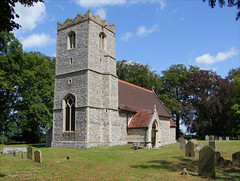
blocked up. The crispness of the tower,
porch and chancel also speak of this
time, but in fact all are 14th Century
survivals, and the tower has a very good
Decorated west window, unusual for
Suffolk. At the other end, the chancel
has a flattened Perpendicular window,
typical of the early 16th Century and
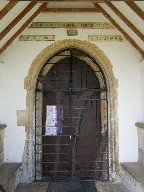
equally unusual. At the time of the
Restoration, the quotation from the Book
of Genesis This is none other but the
House of God and this is the Gate of
Heaven was stencilled above the
south doorway, and there is, as I pointed
out in an earlier entry for this church,
an irony about that.
|
As
lovely as the setting of the church is, its
remoteness unfortunately leads the parish to keep
the church locked. Despite the doorway being the
Gate of Heaven, I had been trying to see
behind it for years. Even coming during Open
Churches Week 2011 didn't help, and I got short
shrift from the churchwardens when I moaned about
this.
Well,
there still isn't a welcoming keyholder notice,
but the emergency contact list gives details of
the churchwarden's address, and it must be said
that he was very nice about it when I called
without making an appointment. The church was
being prepared for a wedding, but I was still
invited in and allowed to wander around exploring
for myself, for which I was very grateful. The
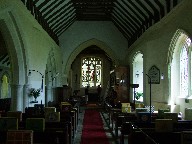
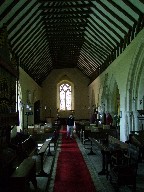
church had undergone a massive internal
restoration about ten years before, when a new
roof was built above the visible scissor-braced
one, and a number of older features had been
brought to light. The church historian Clive
Paine had visited soon afterwards, and his
discoveries added to the interest of the place.
The churchwarden was very informative about
these, and he was clearly very fond of his
church.
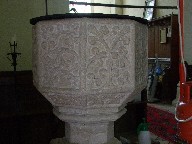
The
carved foliage of the 14th Century font is
beautiful. It must be contemporary with the
rebuilding of the church in the years immediately
before the Black Death. To understand the effects
of that rebuilding, it is only necessary to turn
to the east, when the most striking feature of St
Lawrence becomes immediately apparent. The walls
to north and south suddenly thicken and bulge
inwards, and the only explanation for this can be
that the church once had a central tower. Indeed,
the most easterly arch in the north arcade must
once have been the entrance to a transept from
the crossing. This, then, was probably a Norman
church substantially rebuilt in the early 14th
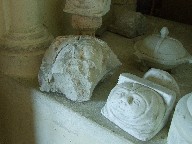
Century. There are little cowled faces forming
corbels to the roof support, and some detached
ones which had been reused as building rubble
were found during the restoration. Also found was
the remains of a carved head, which Clive Paine
suggests was that of a statue of St John the
Baptist from the 15th Century guild chapel in the
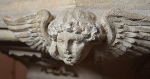
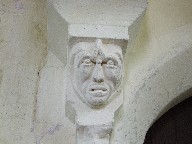
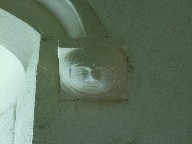
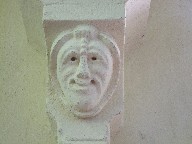
transept here. Rather odder are the two heads
still in situ either side of the chancel, one
scowling and the other smiling in a way that only
reminded me of Stan Laurel.
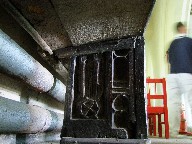
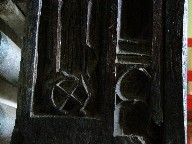
Another
discovery that Clive Paine made was beneath the
medieval bench ends which are built into the long
Victorian bench which runs down the north aisle.
Under the most westerly set can be seen a carved,
broken wheel, the sign of St Catherine.
Interestingly, the nearest other parish church to
here is St Catherine at Flempton, and in the late
19th Century these churches were already in a
joint benefice - so did these bench ends come
from there?
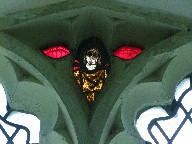
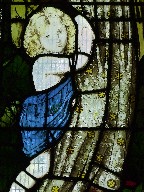
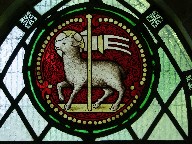
| There is the upper part of a
figure in 14th Century glass in an upper
light of a nave window, quite probably in
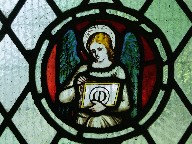
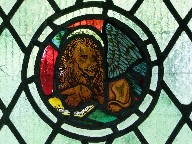
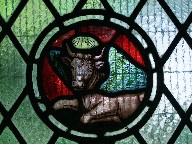
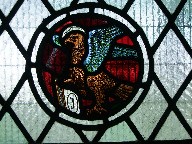
its original setting. There are 19th
Century roundels of the Agnus Dei and the
Evangelistic Symbols in the windows of
the aisle, a memorial to a Victorian
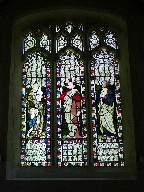
Rector. The only other glass is in the
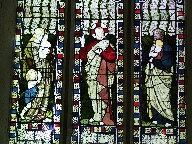
east window, the work of the great Henry
Holiday, but it is really rather poor in
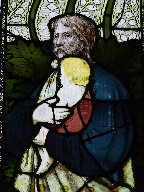
both quality and design. It depicts the
children being Suffered to Come to
Christ; he stands centrally with a mother
and father either side, the bewhiskered
father carrying a baby and a little girl
hiding in her mother's skirts. It was
originally made for Clapton parish church
in London, but it has ended up here. I
was really glad I'd seen inside at last.
This is a fascinating interior, and if it
is not as lovely as the churchyard
outside it makes this quite the most
interesting of the churches in this area.
If only it could be more welcoming!
|
|
 |
|
|
|