| |
|
 |
|
This is a tale of
two visits, one in the depths of winter,
the other on a fine day in high summer
twelve years later. I can tell you now
that on neither occasion did I get inside
this church, so if that is all you are
interested in you may as well stop
reading now.
The occasion of my first visit to Little
Cornard church was on Boxing Day 2000. It
was one of those chilly, damp winter days
when the temperature plummets towards
zero, forgets to stop, and heads below.
That evening, a group of us sat in the
fierce, dark, convivial heat of the Ship
and Star in Sudbury, escaping from the
bosom of our families, and getting
quietly mellow.
This had become something of a tradition
for us; and, it would seem, for other
people too, for the place was heaving. My
friend Stephen (all locals will know his
house on Acton Square, the one with
lifesize Star Wars characters standing in
the windows) was holding court.
Jacqueline discovered a group of old
school friends, and ensconced herself in
a round with them; I was pinned in a
corner with Sarah, who daily commits the
sheer act of lunacy of commuting from
Sudbury to Martlesham, Catherine who
works in a Seventies retro-clothes shop
in Dublin (no, she doesn't commute) and
Nancy, who actually comes from Little
Cornard. |
I had bumped into Nancy and
her mother earlier in the day, on the wild track
that leads through a farmyard along the ridge to
All Saints; but it had been so cold, so bitterly
cruel, and we had all wrapped ourselves up beyond
recognition; so it was only on reflection that
we'd realised who each of us were. And now, my
mind kept going back to that beautiful, secret
place; for the graveyard of All Saints is quite
simply one of the loveliest places in all
Suffolk. As Mr Adnam worked his magic, my
thoughts drifted gently through the icy silence
of the tree-wreathed graves, and the sweet little
church itself.
Anyone who knows Great Cornard, that vast 1960s
estate on the south side of Sudbury, would not
begin to think that its twin in name only could
be so totally different. If anyone knows anything
of Little Cornard, it is probably Martin Shaw's
hymn tune of that name, the most common setting
of Hills of the North Rejoice. So on
Boxing Day morning, we abandoned our children
with their grandparents, and set out to find it.
You leave the centre of Sudbury on the Bures
road, through the light industry and large
Victorian houses, past mundane St Andrew and the
pubs, the roofs of acre after acre of lowrise
council estates below you. After a couple of
miles, the houses thin out, fields appear, a pub
that is very much a village one passes, and you
are in Little Cornard. As you reach the real
countryside, a sign directs you up a steep lane
to the left, and your adventures begin.
The narrow lane climbs steeply between high
hedges, and you hope that you don't meet anything
coming the other way. Soon, you reach the top of
a ridge above the Stour; it is actually the last
dying gasp of the Chilterns as they sink slowly
into the east. The road winds between 18th
century houses and 19th century farm cottages,
doglegging alarmingly at one point, the blind
turn not revealing until the last minute that the
road was flooded on the other side. But we
ploughed on, reaching a farm. A sign indicated
that All Saints Church was across the farmyard,
so we drove in. But the track on the other side
was a swamp, so the very kind lady at the farm
let us leave our car in the farmyard.
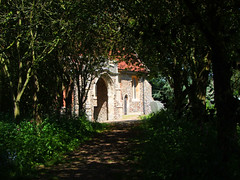
We walked along the track between wild hedgerows
and wooden palings, and eventually found
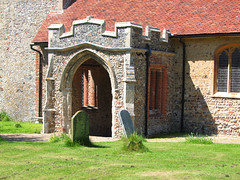
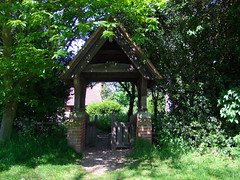
ourselves headed towards a handsome lychgate, the
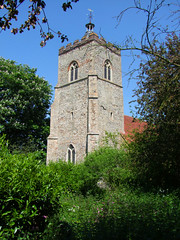
tower and 19th century lantern of All Saints
peeping up above the wilderness of holly, ivy and
yew that surrounded it. Stepping through, we
found ourselves in the most delightful of
graveyards, with scatterings and groupings of
19th century graves among the wild trees; only
the modern graves to the east are organised in
rows. To the east of the church stands a massive
pine tree. This is unusual in Suffolk, where open
churchyards are more the rule these days, and it
places the building in a setting at once
dignified and mysterious, as if nature hadn't
entirely given this place up to the material
world.
My one disappointment of the day followed, for
the church was locked without a keyholder.
Mortlock tells me that much survives of the 14th
century, but that what appears to be a most
curious north chancel chapel is, in fact, a 17th
century vestry, built on two storeys. Looking
through the window, I could see that the
Victorians rather ingeniously knocked the floor
out, and opened the whole thing out into the
chancel. It is now an organ chamber, with the
character of a north transept, as at Baylham. The
19th century windows can be seen through the
clear glass of the north side, where I could also
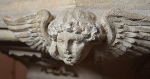
just make out a 15th Century roundel of an angel.
But the churchyard was worth the visit alone.
Here, a strong sense of 19th century
sentimentalism has survived, of that
almost-Catholic piety nurtured by the Oxford
Movement, and then transmuted into emotion by the
sense of destiny of a National Church in
possession. The First World War would overcome
the silliness, and the end of Empire defeat it
all utterly. But that was still in the future.
Death has haunted this little parish. Mortlock
reminds us that it was the first place in Suffolk
to report the Black Death (being, as it is, on
the Essex border) and at least 60 people died; 21
families with land lost all their adults. Here
also, the Danes and the Saxons fought a brutal,
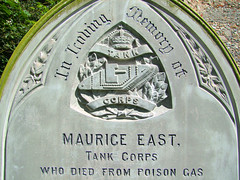
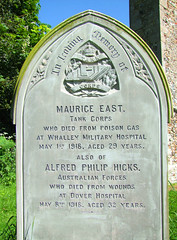
bloody battle. The Parish lost two soldiers in
the First World War, and their joint gravestone
is one of the most explicit I've seen, rather
more moving than the sanitised official ones to
the east of it.
Another very striking feature of the churchyard
was the large number of cast iron gravemarkers.
Many of these are of a broadly similar design,
and cast at the foundry of W. I. Green, at
Sudbury. His nameplate is on the back of several,
and a pair leaning face down display it
prominently. Others are rather more ornate, with
a classical motif of a weeping woman by an urn,
and pious sentiments. I could find no foundry
name on these, but they probably came from the
Melford foundry which specialised in elaborate
memorials.
Most movingly, one of the cast iron markers, to a
child who died at the age of 2 in 1906, still had
fresh flowers before it. I found this again and
again in the graveyard; this is a well-loved,
well used place. On other entries I have been
disparaging about the recreational grave-tending
of the modern cult of the dead; family graves
seem to have taken over from allotments as a
place you make yourself busy, and churches that
were once considered places of private prayer
have been left behind long ago, their doors
locked and untried. But here, there was still a
sense of holy communion between the living and
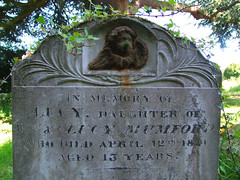
the dead. But why are there so many 19th century
graves here? Can this parish really have been so
big 150 years ago?
 < <  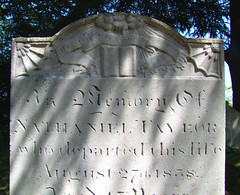
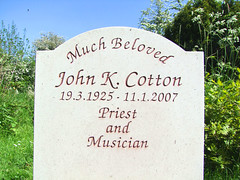 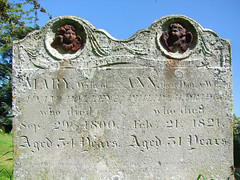 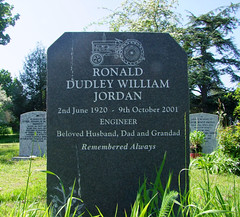
White's Suffolk 1844
records George Mumford at Caustons Hall and
George King at Peacock Hall. William Sandle, John
Bell, Henry Segers and Ann Taylor were four other
farmers. Edmund Tricker was a brickmaker, William
Rayner a blacksmith. William Pochin was Rector,
and that was about it as far as people important
enough to be named go. But 396 people lived here,
scattered across the parish, almost entirely
working on the land, making it a small to medium
sized parish for the time. The population is
about half that today.
If rural populations are declining, it is despite
the efforts of the Knight family. Their modern
grave (mum died only in 1995) is to the east of
the chancel, and the back of it records no less
than SIXTEEN children born to the couple between
1934 and 1957.
And yet, what will remain with me is the
loneliness, the silence of that beautiful spot.
We walked back to the farmyard, wrapped up
against the sub-zero wind, wishing the similarly
wrapped up Nancy and her Mum a good morning along
the path. We drove back down to civilisation,
again being thankful for not meeting another car
on the narrow lane. Modern Sudbury engulfed us
with its noise, but we carried with us the
serenity of lonely Little Cornard. And so it was,
that evening, as I sat happily making a fool of
myself in the Ship and Star over pretty young
things, that I drifted away from the heat and the
noise occasionally, my mind picking its way
between the cast iron graves. I would go back
there.
Well, the years passed. The Ship and Star closed
and was converted into a house. I lost contact
with Catherine and Nancy. And so it wasn't until
the early summer of 2012 that I retraced my
footsteps, in the company of David Striker my
amazing American friend who has visited just
about every church in Norfolk, Suffolk and
Cambridgeshire despite the slight handicap of
living in Colorado City. It was a gorgeous day.
Twelve years had passed, and in any case the
churchyard looked so different under its cloak of
green and white that I remembered nothing. A
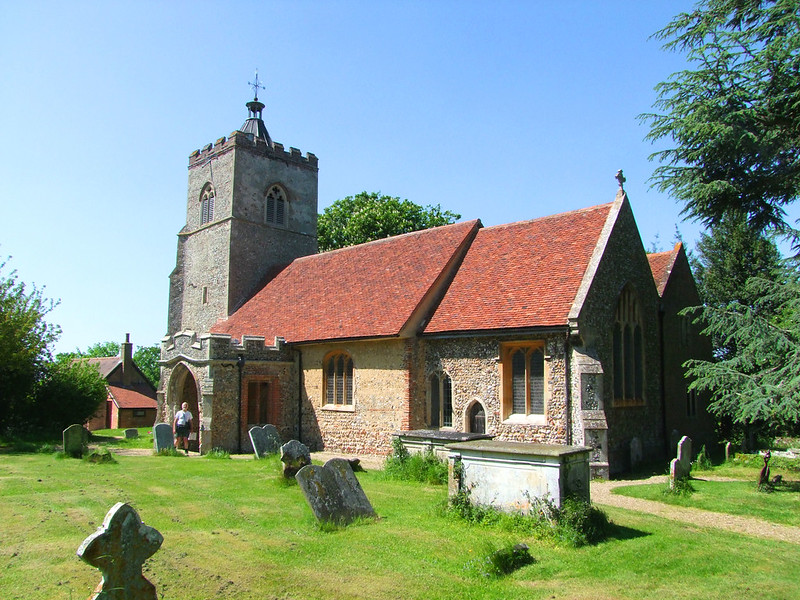
jolly bearded chap was exploring the churchyard -
you can just make him out in the photograph at
the top - and it was a reminder to me that a
number of footpaths meet here, this is a popular
spot for ramblers.
There was still no
keyholder notice, but there was a list of
the churchwardens which gave telephone
numbers. I rang one of them. He wasn't
terribly patient with me - he made it
clear he considered it an imposition for
me to call him. But he said if we were
prepared to wait he'd be there in fifteen
minutes.
Well, fifteen minutes became twenty, and
then twenty became thirty. As lovely as
this place was, there was no way we could
allow this amount of time on one church
when David had travelled from the States
for this trip. So, we left. We headed on
down the narrow lanes and
eventually reached the small town of
Bures beside the River Stour. Here we
stopped at a pub for a pint, sitting in
the garden in the sunshine.
After a while, my mobile phone rang. I
looked down at it, recognising the number
of the Little Cornard churchwarden. It
was almost an hour now since I had spoken
to him. Perhaps he was ringing me up to
apologise for being so late. Maybe
something awful had happened, maybe he'd
fallen down or had an accident or been
prevented in some other way from coming
to the church. But remembering how irate
he'd been when I rang him in the first
place I thought that this was probably
not the case, and so I didn't answer it.
|
|
 |
|
|
|

 <
<  <
<