St Mary, Little Finborough

www.suffolkchurches.co.uk - a journey through the churches of Suffolk
|
St Mary, Little Finborough |
|
|
||
www.suffolkchurches.co.uk - a journey through the churches of Suffolk |
||


Follow these journeys as they happen at Last Of England Twitter.
| Few East Anglian towns have grown
as fast as Stowmarket in the last twenty years or so, and
there seems to be no sign of an end to its greedy
expansion. But it doesn't take long to cycle out of the
town through its suburb of Combs Ford and then up into
the rolling landscape of fields and copses that rises to
the south above the Gipping Valley. You head on through
the old village of Combs and then, just before the road
jinks round into Battisford, there's a view across the
fields to an ancient grove of trees, and nestled within
it you can just make out the little parish church of
Little Finborough. To reach it you take the drive to the
Hall, and then a track takes you further, through the
fields to the churchyard. The setting is a delight, an
ancient churchyard overbowered with trees. I have a fond
memory of sitting here one sunny afternoon during the
Covid spring of 2020, the baby squirrels playing around
my feet. The church was closed because of the pandemic,
and out here they had obviously never seen a human being
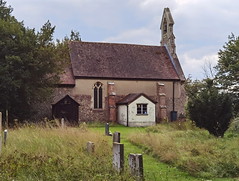
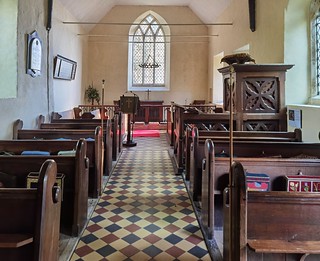
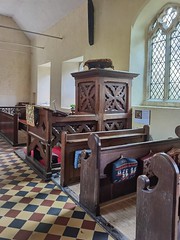
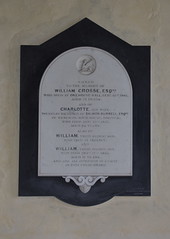
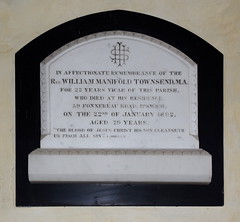
before. This is a scattered parish, and there is no village. The church is not large, being a pleasant little two-celled building with a bellcote. The origins of the present structure are in the 14th Century, although interestingly Simon Cotton points to a 1511 bequest by John Rushbroke, a Gentleman of Ipswich St Peter, who left to the reparacion of the littil church of Finburgh Iiijs iiij, which is to say four shillings and fourpence. This was not a huge amount, and may just have been for a necessary repair. In any case, the church as we see it today is mostly the result of Edwin Grundy Pennington's 1856 restoration. Pennington had been responsible for the chapels in Stowmarket Old Cemetery the previous year, but it isn't entirely clear who he was. The Builder of 21st March 1857 recorded that the church has been lately reopened having been restored... the building work was executed by Mr Betts of Stowmarket, the architect was Mr Edwin G Pennington of London. Birkin Haward notes that Pennington was ARIBA credited in 1854, only just before his Suffolk work, and he may well have been the Edwin Grundy Pennington born in nearby Darmsden in 1832, although this would have placed him in only his early twenties when he carried out his work in Suffolk, and there would be no more in the county. Perhaps local connections had got him the jobs. The church is open every day, with a timelock on the door to open and close it. You step into a charming interior, the floor a mosaic of coloured tiles. This floor was repaired in the summer of 2022, and churchwarden Ken Mudd tells me that they found the tiles to be of early 20th Century origin, and so not from Pennington's restoration. The font was set lower as part of this retiling, its pedestal removed, and it now seems to grow organically out of the tiles. Turning east, the simple benches are all of a piece, and it is easy to imagine this place when Pennington's restoration was new in that world now so far out of reach, the ploughmen and the blacksmiths, strong of arm and strong of voice, shuffling their bottoms on the benches, the ladies in complicated hats, the young men home from colonial wars. The robust Low Church tradition here is reflected in Pennington's furnishings, most notably by a double-decker pulpit, a rare thing to find in a 19th Century restoration. The sanctuary beyond is plain and simple, the 1890s altar carved with the imposing words ye do shew the Lord's death till he comes. Above this is a brass dedicatory inscription to Charlotte Townsend, the widow of the Reverend William Manifold Townsend who was incumbent here for twenty-two years. His memorial is set on the north wall. Further east on this wall, the large decalogue panel is from the now-redundant church of St Nicholas, Wattisham. Above all this, the surviving tympanum that marks the break between nave and chancel has a royal arms of George III set in it, dated 1767. I'm told that the remains of an earlier set of arms can be detected under the paint in certain lights. Royal arms were originally set in this position by decree in the reign of Elizabeth I, but very few are still in their original position now because in most cases they were removed to the back of the church by the Victorians, who were trying to restore a sense of the sacramental. That this did not happen here is of a piece with Pennington's restoration. When the late Sam Mortlock came this way in the 1980s he found the church still lit by oil lamps and candles, but there is electricity now. Going further back, it's hard to get a sense of the pre-Reformation interior that was once here, but about twenty years ago part of a 14th Century wall painting was uncovered on the north wall. It shows a small figure in red and yellow ochre with one arm raised. He may well be one of the figures in a Three Living and Three Dead painting, a nobleman holding a falcon on his wrist perhaps. Equally it may be a figure from a legend sequence, perhaps that of St Christopher. At the time of the 1851 Census of Religious Worship the population of the parish was just sixty-four, making it one of the smallest in Suffolk. The incumbent was Frederick William Freeman, who claimed an average attendance for Sunday morning worship at Little Finborough of thirty, and for the Sunday afternoon sermon with which it alternated of forty-five, which seem remarkably high figures. Few Suffolk churches could claim such a large proportion of the population of their parish tipping up on a Sunday, and so it might been the influence of the local landowners, the Crosse and Turner families, who probably employed most of the parish. Further, this did not include scholars, for as Freeman pointed out, there was no Sunday School, the children of this parish being on books of Great Finborough. Freeman styled himself Vicar or Perpetual Curate in the return, which is to say that he did not directly receive the rectorial income. This came from interest on land, and went, he pointed out, to the patrons, the provost and Fellows of Kings College Cambridge, who take all tithes, great and small, and 35 acres of land has by some means or other been lost to the living. As incumbent at Little Finborough, Freeman received a stipend of £96 annually, roughly equivalent to £19,000 in today's money, but he went on to complain that the Provost and Fellows... have not for the last two and a half years paid officiating minister any stipend. Freeman was also the chaplain of the Stow Union workhouse for which he received a stipend of £50 a year, about £10,000 in today's money, hardly enough on its own for a clergyman to live on even with the benefit of a vicarage in Stowmarket, so perhaps he had another source of income. William Manifold Townsend, his successor at Little Finborough whose wife is the dedicatee of the altar and who is remembered on the north wall, overcame this difficulty, for he had married into the wealthy Crosse family of the Hall. Stepping back outside into the secretive churchyard, the only sound was the early spring chatter of a robin and a couple of chiffchaffs. To the west of the church is a charming little hut which turns out to be a churchyard toilet. I wonder what the Reverends Freeman and Townsend would have made of that. A footpath runs from the churchyard northwards across the fields towards Great Finborough, and the visitors book inside the church here bears witness to the number of walkers who stop off at the church, perhaps to sit on a bench and eat their packed lunches. It was easy to imagine the mid-19th Century children of Little Finborough wandering down it on a Sunday morning to divine service and Sunday School at Great Finborough church, whose strange spire rises from the mist below. After about a mile the track reaches a tarmac road, passes the house where the DJ John Peel lived and had his studio for more than thirty years, before undulating for another mile or more up and down to civilisation and Great Finborough high street. It must have made quite a journey for all those little Victorian legs, especially on a winter's day. |
Simon Knott, February 2023
Follow these journeys as they happen at Last Of England Twitter.




|
||||||||||||||||||||||||||||||||||||||||||||||||||||||