| |
|
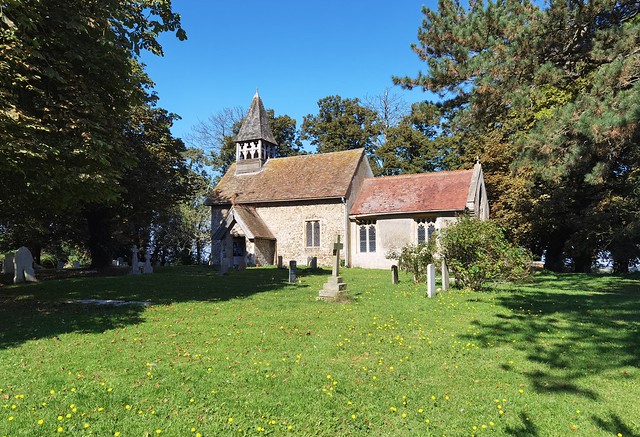
On the map Little
Wratting church appears to be set in a fairly
remote spot, down a narrow lane away from the
point where the busy Newmarket to Haverhill and
Haverhill to Bury roads meet in the hills of
south-west Suffolk. The pretty little church
sits in an idyllic little churchyard, though the
meat processing plant visible beyond the trees in
the valley below, and the noise of traffic on the
roads, bring the 21st Century a little too close
as you stand in the churchyard. There is no
tower, and the bellcote-surmounted tiny nave
makes this appear a dolls house of a church, a
reminder of how close we are to north Essex here
where this little church would be quite at home. Intriguingly,
a bequest of 1424 survives in which the rector
John Howlett left in his will the residue of
goods to building the church of Wrottyng Parva
and its tower. Since both nave and chancel
appear in their origins earlier than this, and
there is no tower, it seems the work was never
carried out unless the tracery of the chancel
windows is from this time. Indeed, the fabric
here tells of an age much earlier than most
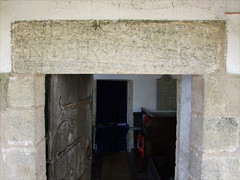
Suffolk churches, for above the south doorway is
part of a Saxon dedicatory inscription. Of course
this may not have come from this church
originally, but Pevsner also pointed out the
Saxon origins of the chancel, and we are on a hilltop in a
circular churchyard, so this is likely an ancient
site. You can make out the towers of two other
hilltop churches from the edge of the churchyard,
although towerless Little Wratting church's
bellcote is a fruit of the substantial 1895
restoration.
The ironwork of
the south door appears to be late Norman, and
perhaps the woodwork is too. You step through it
into a small space which inevitably has a feeling
of being crowded and perhaps even a bit gloomy,
the floors replaced by 19th Century tiles, but
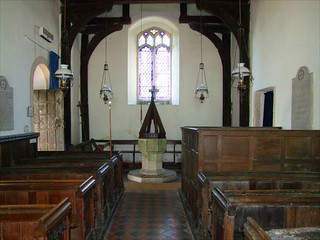
still it is rustic and moving. There is a fair
amount of old woodwork, albeit knocked about a
bit over the centuries. A large 18th Century box
pew has been cut into the back of a line of 15th
or 16th Century benches, the one closest to it
braced against it. The view to the east is
dominated by a curious faux-Norman chancel arch
which Pevsner attributed to the 1890s
restoration. Its deep interior surface is flat
and patterned in brick, and it looks very much in
the style of the early century to come. An
elegant little screen is set inside it and you
step into a chancel which is much lighter than
the nave.
Here, the tiles,
sanctuary rails and candle holders, and the clear
light from the east window, give the feeling of a
dusty chancel that is frozen in time, captured at
the end of the 19th Century as if it might still
be home to the Prayerbook liturgy and the
Anglican revival of those years. Before the
restoration there was a ruinous chapel on the
north side of the chancel for the Turnour family.
Nothing of it survives, or of their memorials,
except for a single kneeling figure rescued from
the churchyard and now set on the windowsill on
the south side of the chancel, the saving
remnant.
|
|
|