Holy Trinity, Middleton

www.suffolkchurches.co.uk - a journey through the churches of Suffolk
|
Holy Trinity, Middleton |
|
|
||
www.suffolkchurches.co.uk - a journey through the churches of Suffolk |
||

Follow these journeys as they happen at Last Of England Twitter.
Middleton is one
of those fairly sizeable, self-contained villages with
its own pub and school, that you still occasionally find
in the east of Suffolk. It would be quite possible to
live here, using the the shops at Westleton and
occasionally going into Leiston for a night out, without
ever worrying about what the wider world was up to.
Dunwich Heath and the Minsmere bird reserve lie to the
east, and the Leiston to Blythburgh road bypasses the
village, so unless you are a making an expedition to the
church or the lovely Bell pub on the other side of the
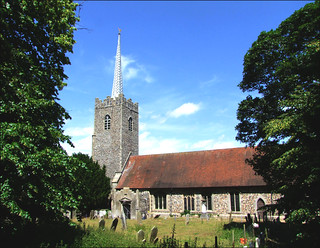
village green, you will probably not know Holy Trinity. A
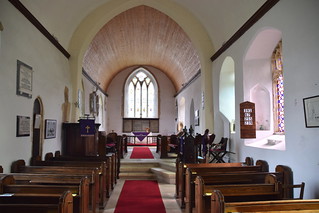
surprise, then, because this is a dramatic building with
its bold tower and tall lead spire rising above the
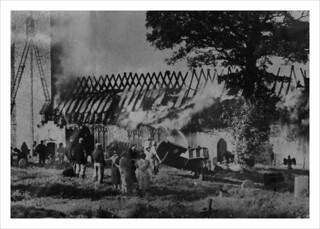
cottages and treetops. By 1955, the spire of
Holy Trinity had become quite unsafe, and was completely
rebuilt. One summer morning, as two workmen were putting
the finishing touches to the lead around the base of the
spire, they looked down to see smoke rising from the
thatched roof of the nave below. By three o'clock that
afternoon, the church was completely ablaze.
The church had some
ancient treasures, all of which survived the
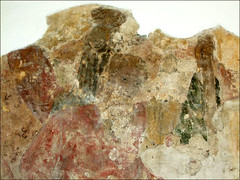
conflagration, more or less. One is a massive St
Christopher wall painting, first uncovered in 1908. It
was damaged by the smoke and water, but has since been
restored. The three figure brasses, two medieval and one
early-modern, were set in the floor, so they did not
melt, but a burning beam fell and smashed the head off of
the 1610 brass to Sir Anthony Pettow. This head was lost,
presumed destroyed. However, in 1990 the owners of the
Old Rectory were gardening in the area where the
cartloads of burnt thatch had been dumped thirty-five
years before. They found the remains of the head. It has
now been reunited with its body, which is in such a
delicate state that it has been reset on a wall, so I
fear it would not survive another fire. It is worth
pointing out that fires in thatched-roof churches tend to
do less damage than those in more substantially-roofed
buildings, because the heat is so easily able to go
upwards. Simon Knott, July 2019 Follow these journeys as they happen at Last Of England Twitter.
Amazon commission helps cover the running costs of this site
|