St Peter, Moulton

www.suffolkchurches.co.uk - a journey through the churches of Suffolk
|
St Peter, Moulton |
|
|
||
www.suffolkchurches.co.uk - a journey through the churches of Suffolk |
||

Follow these journeys as they happen at Last Of England Twitter.
| If you draw a straight line
between Cambridge and Bury St Edmunds it passes through
Moulton, and so does the River Kennett on its way towards
the Great Ouse and the sea. Nowadays the awful A14
thunders past some three miles to the north of here, but
for centuries travellers between Cambridge and Bury came
this way, crossing the river on an ancient packhorse
bridge which still survives, the river now culverted
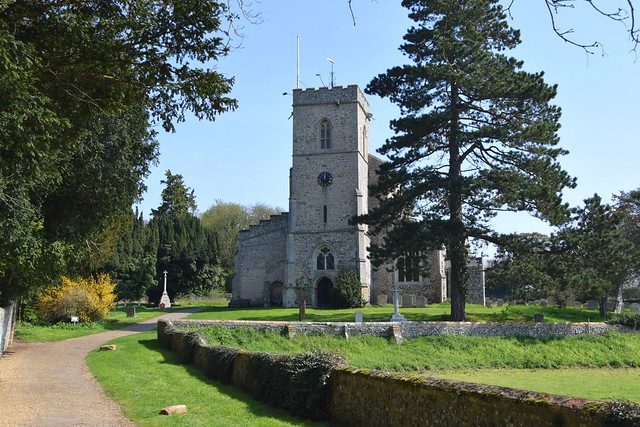
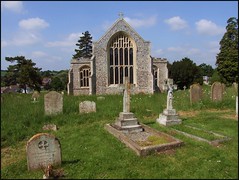
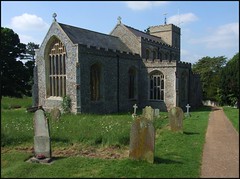
beneath it, in this lovely village. The church is grandly
set above the river, with a ford below, the bold west
frontage of its early 14th Century tower facing
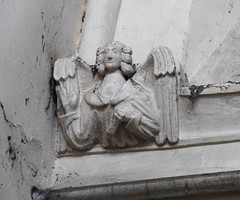
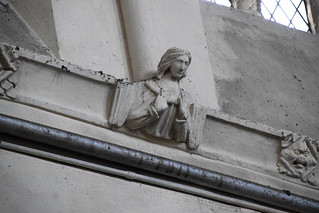
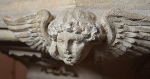
dramatically across the valley. Apart from the tower everything was rebuilt right at the end of the medieval period and what you see is all a kind of grand late Perpendicular, but as James Bettley observes in the revised Buildings of England, it is so restored (J F Clark, 1851) to make one think it, at first sight, Victorian. This isn't just a matter of the patina of age, for you step into a tall, open nave which is unfamiliar, the wide arcades ranging high above the floor and managing the run from west to east of this large church in just three bays. The transepts to south and north have arches westwards into the aisles, that to the south aisle curiously low. All these arches bouncing around below the tall clerestory distract the eye at first from the chancel arch and chancel, which is to say that they do not fulfil one of the usual characteristics of Perpendicular architecture, to lead the eye eastwards. This, coupled with the lack of any coloured glass in the tall windows of the nave gives an overwhelming effect of a kind of spartan elaborateness, if such a thing is possible. All of this seems likely to be of the early 16th Century and to have been at worst recut in Clark's restoration. The chancel beyond is similarly tall but disproportionately narrow, an effect emphasised by the width of the aisles. The frieze of angels and lion faces that runs above the arcades beneath the clerestories in the late 15th Century style is striking and memorable, though how much of it is late medieval it is hard to say.
One thing I hadn't seen on my previous visits to Moulton has now been set for display beside the tower arch. For many years it was kept hidden away in the vestry. This is a Romanesque carving, probably 11th Century, of a sheela-na-gig and an accompanying male figure. As James Bettley notes, the figures are crude and suggestively sexual, but exactly what the sculpture represents, and where it came from, is unexplained. It is unusual for a sheela-na-gig to be accompanied by a male figure, but you can see something similar not far from here on the tower at Whittlesford, Cambridgeshire.
The 19th Century font has alternate panels of fleurons and the Instruments of the Passion, and there are a couple of memorials. As often, the most moving ones are the smaller, more recent ones. Guy Robins, a sergeant in the 7th Suffolks, died of wounds received in action on 22nd June 1915. Saddest of all is to a young man, 18 years old, killed in the air disaster at Ermenonville, France on 3rd March 1974. He was one of the members of the Bury St Edmunds rugby team which had travelled to France to take part in a tournament. The eighteen of them on the return flight were among the three hundred and forty six people killed in what was at the time the worst civil aviation disaster in history. But really this building is mostly memorable for the bones of its early 16th Century rebuilding. This was architecture for the mind rather than for the heart and soul. Our ancestors, made serious by the Black Death and the events afterwards, were now living in a world of merchants as well as of peasants, of squires and of landlords who touched their lives more than Kings, Dukes and Earls ever did now. It is small wonder that they were fruitful ground for protestantism in its many shapes and forms when it finally came along. |
Simon Knott, September 2021




Follow these journeys as they happen at Last Of England Twitter.
|
||||||||||||||||||||||||||||||||||||||||||||||||||||||