St John the Baptist, Onehouse

www.suffolkchurches.co.uk - a journey through the churches of Suffolk
|
St John the Baptist, Onehouse |
|
|
||
www.suffolkchurches.co.uk - a journey through the churches of Suffolk |
||


Follow these journeys as they happen at Last Of England Twitter.
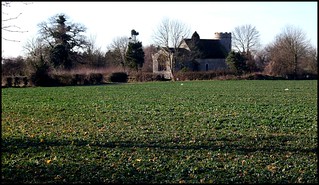
| Onehouse is one of those hilly
parishes on the outskirts of Stowmarket, and although the
parish includes part of the urban area of its neighbour -
indeed, the Stow Union Workhouse, today converted into
apartments, was in Onehouse parish - the village that
shares the parish name is over the hill from there, and
you wouldn't know. The church itself, like several around
here, is small and out in the fields a quarter of a
mile's walk, cycle, or bumpy drive from the nearest road.
In the misty light of a winter's day it looks haunting
from a distance, as if from any time, and it reminds me
of this church's few moments of fame back in the 1970s,
when it appeared at the opening of an episode of the
popular BBC TV series The Survivors, which was
partly filmed on location in this part of Suffolk. The sense of timelessness extends to the
small graveyard, with its scattering of mainly 19th
century headstones. By the western hedge, a beautifully
cut stone is inscribed with initials and the date 1846.
You can't help thinking that not much has changed here
since then, but in fact that wouldn't be correct. When
Mortlock came this way in the 1980s, he found a tall
tower with obvious Saxon features. However, by the 1990s,
this tower had become unsafe, and somewhat barbarically
it was reduced by two thirds in height, and then partly
built up again with modern battlements. For this reason,
St John the Baptist today appears to be a different
church from the time of its fifteen minutes of fame. You
can see a screenshot from The Survivors at the
bottom of this page, showing the church with its tower
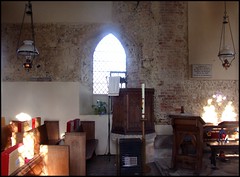
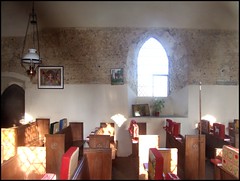
intact. But I must finish by saying that I have
been inside St John the Baptist, and the memory of that
occasion sticks like a burr in my mind. It was in the
early summer of 1997, and we came here for the blessing
of the marriage of my friends Simon and Sarah. At the
time, my wife was seven months pregnant, and so she sat
on a chair by the font, with a cool breeze carrying
birdsong through the ancient south doorway from the
rising barley beyond. It was a joyous occasion; but, in
retrospect, one tinged with sadness. This was the last
time I saw my friend Brian, who was to die of a heart
attack on a lonely night train across America a few weeks
later. |
Simon Knott, January 2021
Follow these journeys as they happen at Last Of England Twitter.

|
||||||||||||||||||||||||||||||||||||||||||||||||||||||