
St Michael, Rushmere

www.suffolkchurches.co.uk - a journey through the churches of Suffolk
|
St Michael, Rushmere |
|
|
||
www.suffolkchurches.co.uk - a journey through the churches of Suffolk |
||


Follow these journeys as they happen at Last Of England Twitter.
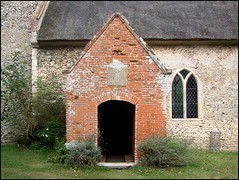
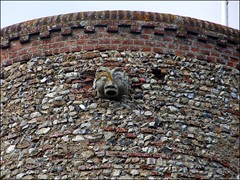
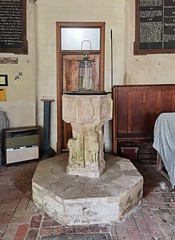
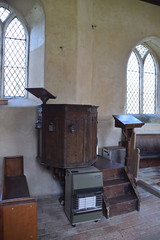
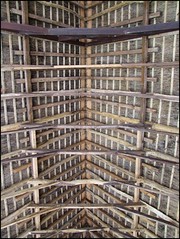
It was a joy to be out in the unseasonably warm weather of March 2022, cycling around the narrow lanes of north-east Suffolk. This landscape of gently rolling fields and woods is criss-crossed by a network of ancient byways that seem to wander off to nowhere in particular before meeting up again as if at some pre-arranged destination. Where four narrow lanes come together stands the church of St Michael, Rushmere. There is no real village centre, the Hall, a farm and a few cottages being some distance to the south, and the population of the parish today is probably best measured in tens rather than hundreds. At the time of White's Suffolk Directory of 1844 there were 134 inhabitants, and I dare say that there are fewer people than that today. Nevertheless, the large northern suburb of Ipswich with which it shares its name is always referred to as 'Rushmere St Andrew', whereas this tiny, remote parish forty miles off is simply 'Rushmere' on the maps. Rushmere's round tower with its flag flying is a pleasing and even moving sight, because when Cautley's revising editors visited this church in 1975 they found it roofless and abandoned. The furnishings had been dispersed,and it seems likely that the intention was to leave it to quietly fall. Ironically, it was perhaps that the parish church a mile off at neighbouring Mutford was being considered for redundancy that galvanised local people into action. One lost church is unfortunate, but two looks like carelessness, and today both Mutford and Rushmere have working churches again. When Sam Mortlock visited in the late 1980s the church was still in a derelict state, but already he saw how local people were doing something about it. The reeds were stacked ready for thatching, and the walls were being repaired. Visiting today, you can immediately see the difference that local pride and loving care can make. For this little church, which has suffered centuries of neglect, stands trim and proud in its pretty churchyard. What we see today is mostly of its Norman origins, although the chancel had a makeover and the windows and bell openings all seem to have been replaced in the early 14th Century. Three hundred years later, the 17th Century brought the red brick porch and probably the red brick battlement stage of the tower. Stepping through the porch you enter a narrow space, the light cast through the clear glass of the windows. There is no electricity, and candles are set on large candelabras. Like many churches in this part of Suffolk, it is a long, tunnel-like building, with no aisles and no obvious division between nave and chancel, although this is more apparent from the outside. The furnishings were returned, but now they stand directly on the brick and tiled floors, the wooden platforms that once supported them having rotted away during the long years of neglect. There is no ceiling, and so you can see up into the underside of the exposed thatch. The font is a battered
example of the typical 15th Century East Anglian style,
seeming more imposing here than it would in a larger
church. Turning east, there are several interesting late
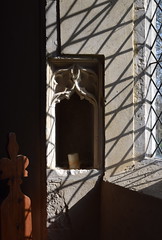
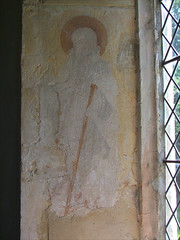
medieval survivals, two of them set in window splays. On
the south side of the nave, one of the windows has a wall
painting of St Anthony. He carries his pilgrim staff and
rosary, and at his feet his little pig looks up at him
adoringly. Beyond, in the chancel, is a fine early 14th
Century piscina. Between the two, some fragments of
decorative wall painting probably date from when the
window tracery was replaced, the piscina installed and
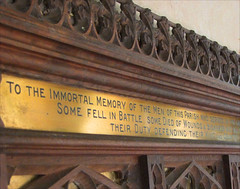
the chancel given a general makeover. On the north wall
is a large roll of honour, stored for many years at
Mutford, but now returned to its rightful place. It is
similar in design to those at Mutford and Gisleham. Simon Knott, April 2022 Follow these journeys as they happen at Last Of England Twitter. |








|
||||||||||||||||||||||||||||||||||||||||||||||||||||||