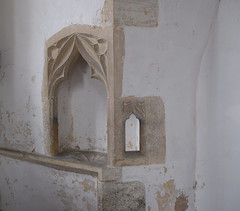
This lonely church
sits not half a mile from its neighbouring church of All
Saints, Honington, although you will have to go rather a
long way round if you are not on foot and able to take
advantage of the footbridge over the River Blackbourne.
St Andrew is set in rolling meadows, with the fields of
the Euston estate beyond. It is not entirely alone, for
nearby company consists of a huge farmhouse and a
restored barn.
I have a very vivid memory of visiting this church in the
early weeks of the new Millennium. At the time, I was
doing a job I did not like, having been moved sideways by
a manager whom I did not find it easy to work with. This
made me depressed, and on a bright morning in early
spring I got up and decided that I did not want to go to
work.
Instead, I set off with my wife and our infant daughter
into the countryside, and we ended up here. I remember
sitting in the porch that day in the bright, low
sunlight, listening to the small birds weaving around the
graveyard. The sun warmed me, the birdsong lifted my
heart, and I knew, if I had not known before, that there
is more to life than getting and spending, and times
would change, and the world would move on. And so it did.
St Andrew is an old building, and it looks its age. It
was hardly touched by the enthusiasms of the late
medieval period, and the 19th century restoration was
early and light. It retains all the character of an
intensely rural parish church. This is helped by the fact
that it has been redundant for more than a quarter of a
century, and the Churches Conservation Trust looks after
it. They have cleared it of clutter and left it as an
ancient space should be, peaceful and purposeful.
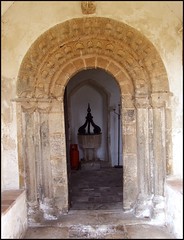
It's usually the chancel door that's left unlocked, but
if you head straight there you will miss the great glory
of Sapiston church, which is within the south porch,
quite the best Norman doorway in Suffolk, elaborate and
beautiful. The extent of the convoluted arches is
accentuated by the smallness of the doorway. It takes the
breath away. There is nothing like a Norman doorway for
restoring ones sense of proportion. It has stood there
for nearly 800 years, which kind of puts your own
troubles into perspective, don't you think? The blocks
are set together in pairs, each one reflecting the scoop
of its partner. Those in the inner arch are slightly
larger than those in the outer arch, and the illusion is
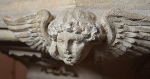
of a peacock displaying its tail feathers. A medieval
head looks down from above it. At either end is a mass
dial, from the days before the 14th century porch was
built.
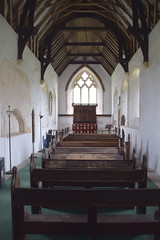
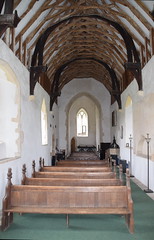
You step in to a
gorgeous, rustic little interior, narrow, crowded, rough
and ready. There is a transparent coolness in the stone,
intensified by the thick Norman walls. The stone blocks
on the floor, the spaced benches, create a sense of a
different time, outside the loss of nerve and limited
imagination of the modern world. The walls are
whitewashed, except for where wall paintings remain.
There are several large consecration crosses, and above
the alcove of a former tomb recess in the north wall, a
wall painting can just about be discerned as showing the
martyrdom of St Edmund as at Troston across the fields.
Beside it, a perfect rood loft stairway entrance.
An interesting feature is the set of Royal Arms. It is
that of the House of Hanover, but again as at Troston
this is a reused Stuart set, this time the floriated
lettering and hastily inserted 2 giving the game away if
the crudely repainted fourth quarter doesn't.
PH Ditchburn, in his enchanting 1913 celebration The
Parish Clerk, recalls an incident at Sapiston church
in the middle years of the 19th Century. The Duke of
Grafton, on whose estates surrounded the church, was
passing it on a Sunday while a service was on. He entered
the vestry, motioned to the parish clerk to come out, and
presented a large hare for the parson's kitchen, asking
the clerk to put it quietly into his trap and inform him
of the Duke's compliments at the end of the service. But
the clerk, knowing his master would be pleased at the
little attention, could not refrain from delivering both
hare and message at once before the whole congregation.
At the close of the hymn before the sermon he marched
into a prominent position holding up the gift, and
shouted out "His Grace's compliments, and please
sir, he's sent ye a hare."
Twenty years ago I wrote that Sapiston church is a place
to come to if you want to feel serene and human again,
and to have your heart lifted. I've been back here now
half a dozen times I suppose, but visiting in the late
spring of 2019 I still felt this. It is always salutary
to recall less secure and comfortable times from the
vantage point of happier days. There is a pleasure in
knowing that you have survived them.
I wandered around the lonely graveyard. In the middle of
the day the sky had clouded over in the heat, the
boilings of cumulus clouds that had accompanied me from
Bury St Edmunds merging and dropping to form a blanket
that swept in from the northern horizon. It would rain
later, but for this perfect moment under the low sky I
was alone with the gravestones, some dating back into the
17th century, their skulls and cherubs and hour glasses a
warning of mortality, but also a reminder of the
preciousness of life, as precious for me as it was for
these, now resting forever in the birdsong on the bank of
the River Blackbourne.