| |
|
Like many medieval
churches in Suffolk, St John the Baptist is
remote from the village it serves. Or, it would
be more accurate to say that the village is
remote from the church, since the church stands
on the main road from the A12 to Aldeburgh, and
the village is off this road, a mile or so to the
south. The position of the church probably
reflects the fact that it is high, firm ground,
while the village is in the marshes.
This is not to say that the village is not a busy
place too of course, for just across the River
Alde, and actually in Tunstall parish, are the
world famous Snape Maltings, once the dockside
and railhead of the Garrett industrial empire,
and now home to the Aldeburgh Festival.
Ironically, the tourists that flock the craft
shops, galleries and cafes of the Arts Centre,
and go for walks along the reed-banked creeks and
across the marshes, probably don't often make it
up to the busy top road and the church.
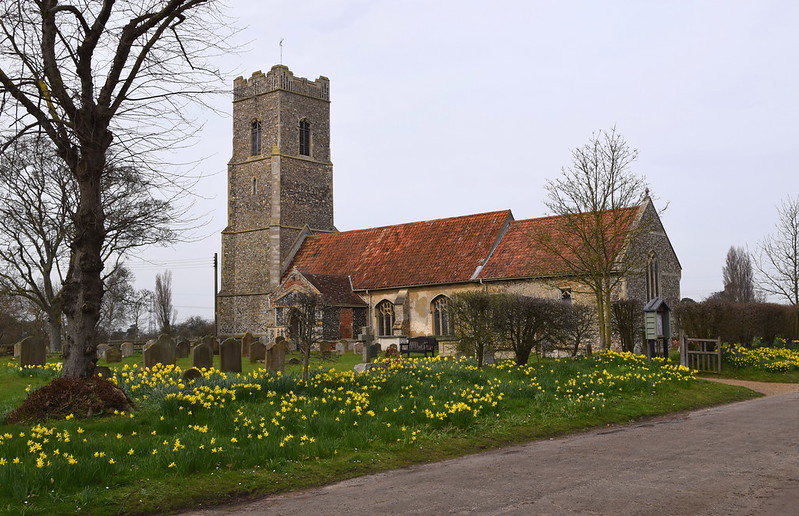
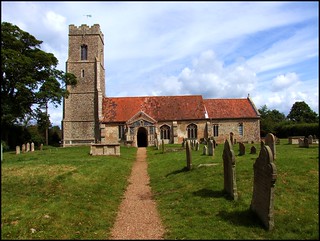
The building today looks pretty much like
Ladbroke's 1820 drawing. The Victorians didn't do
much here, there was no building of aisles,
transepts or trimmings. The only real change is
the eastern wall, rebuilt in 1920 to replace the
heavily buttressed yet collapsing original. This
is a simple, aisleless church, with no
clerestory. The roofline on the tower shows that
it was once thatched. It is, let us say, a
typical country church. The tower was built as
the result of a bequest in the middle years of
the 15th century, and the battlements added
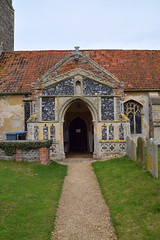
later, in the style of the 1520s. The porch is
contemporary with the tower. The nave and chancel
are earlier, probably 13th century, and although
they have been patched up over the years, there
has been no wholesale rebuilding.
Inside, however, the modern age has been busy.
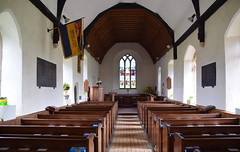
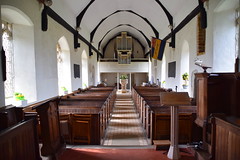
You step into an utterly charming interior, full
of light, with white walls and brick floors. At
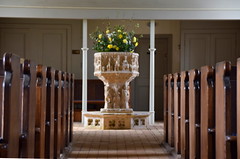
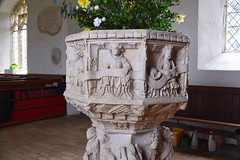
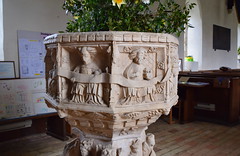
the cleared west end is the church's great
treasure, one of the most beautiful fonts in the
county. It bears a dedicatory inscription to the
Mey family, and dates from the late 15th century.
Strange animals lurk around the foot of it, and
tthe stem bears the Evangelists with their
symbols, interspersed with kings. But the most
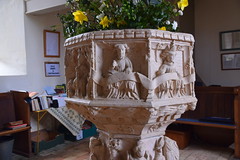
animated figures are those on the bowl. Seven of
them hold a long scroll that goes right around
the bowl. The eighth panel is a rare
representation of the Holy Trinity, which was
particularly circumscribed by iconoclasts in the
16th and 17th centuries. It shows God the Father
seated on his throne, with the crucified Son held
in front of him. The Spirit descends in the form
of a dove. On either side kneel the donors of the
font.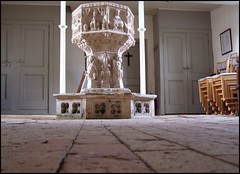 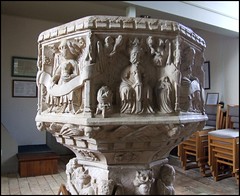
David Davy, visiting in the
1830s, said that the whitewash had been recently
removed from the font. Perhaps what he meant was
that the figures had been covered in plaster,
which would explain their survival. Certainly,
the puritan iconoclast William Dowsing saw
nothing to incur his displeasure when he came
here in 1644, and almost certainly the Anglican
reformers had plastered it over a century
earlier, the usual way of dealing with the
problem of removing images while not actually
destroying the font, which was still required by
the new religion.
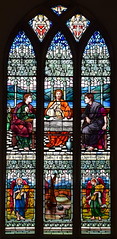
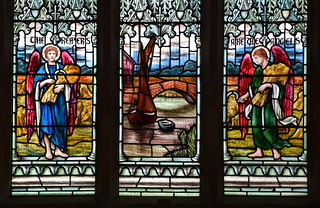
The views to east and west are beautiful, the
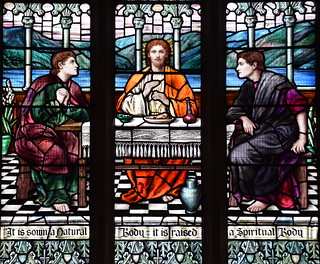
colour of the Arts and Crafts east window
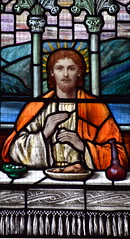
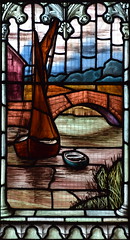
perfectly poised and balanced. In the top half,
Christ breaks bread at supper at Emmaus. Below,
two angels flank the River Alde at Snape Bridge.
It dates from the 1920 restoration, and is by
Mary Lowndes, perhaps the leading female artist
in any medium of the last years of the 19th and
first years of the 20th centuries. She is best
known today for her work for the suffragette
movement - she designed their posters. Through
her work at the Glass House she was an influence
on many younger artists, both male and female.
Below it, there is often
set a beautiful altar frontal, illustrating a
line from Eliot's Four Quartets. The
church used to have a 15th century brass of five
little girls. Davy made a rubbing of it, which is
in the British Museum, but the brass has been
stolen or mislaid since, probably in the 1920
wholesale refurbishment of the chancel.
Outside in the graveyard, the war memorial is one
of the most extraordinary in Suffolk, a
broken-down classical feature looking down the
road to the village. Unfortunately, it is not a
pleasant walk because of the traffic, but there
are a couple of good pubs, and the walks across
the marshes beyond the Maltings are certainly
worth the effort. Not far off is Snape Mill,
bought by the young Lowestoft-born Benjamin
Britten as a place to write, and to which he
returned from America at the height of the War.
He had read an article about George Crabbe's poem
The Village with its account of the
fisherman Peter Grimes, and knew that back home
in Suffolk was where he had to be, and an opera
based on the poem was what he had to write.
|
|
|