| |
|
Follow these journeys as they happen at Last Of England
Twitter.
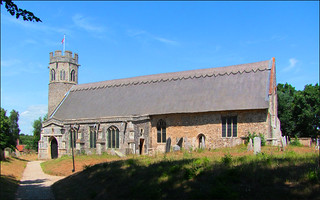
Theberton is a sizeable village strung out
along the main road to the north of the town of Leiston.
The church has one of Suffolk's prettiest round towers,
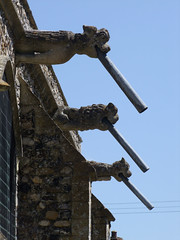
and loveliest thatched roofs. Gargoyles grin down from
the late medieval south aisle, a 1483 bequest by Sir
William Jenney, but substantially restored, perhaps even
largely rebuilt, in the 1840s by Lewis Cottingham for
Charles Doughty, who was not only the rector but also the
wealthy owner of Theberton Hall. He intended it as a
family aisle, in one of those 19th Century conceits which
tried to imitate the pretensions of the medieval landed
gentry, and the relatively early date of the restoration
might explain its rather jolly pre-ecclesiological
gothicky feel.
But Theberton is also home to a rather
grimmer tale. On the night of 17th June 1917, on the edge
of this village, German Zeppelin airship L48 was brought
down, with the agonising death of 16 of its crew. Finding
yourself on fire and falling through the air cannot fill
you with much hope of your survival, but remarkably some
of the crew did survive, to be rounded up by the local
constable, who I like to imagine arriving on his bike.
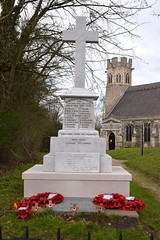
The dead were buried in the graveyard extension here,
before being moved to a military cemetery 60 years later,
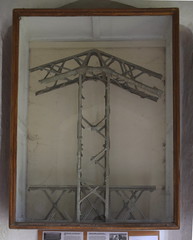
but their memorial remains. In the porch there is part of
the superstructure of the giant airship, incongruous in a
glass case. The story below it makes fascinating if
slightly harrowing reading. Within the time I've lived in
Suffolk I've met locals who still talked about the
Theberton airship crash, although of course they must all
be dead by now, but many must be the households in the
parish which still retain part of the skeleton of the
ship.
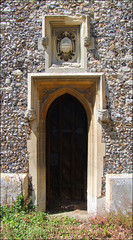
The south porch was restored at the same time as the
aisle, but the most memorable part of the 1840s
restoration becomes evident as you step into the nave,
for the south arcade has been painted with extravagant
stencilling, as if it had been tattooed. We know that
much wood and stonework was painted in medieval times
with geometric designs, and some survives in Suffolk at
Kedington and Westhorpe. It is interesting to see an
early 19th century interpretation. It is said that
Cottingham based the scheme on traces of paint found on
the arcades. The work was carried out by Thomas
Willement, better known for his glass, which is also
here, depicting St Peter and St Paul flanked by the
evangelistic symbols in the south windows of the aisle.
The arcade lends the interior a somewhat idiosyncratic
feel, as you may imagine, but it does help distract from
what is certainly not the best early 20th century glass
in Suffolk. The Ward & Hughes memorial window to
Charles Hotham Montagu Doughty, who was killed leading a
charge in the Dardanelles in 1915, is particularly bad,
depicting the portly, balding Doughty as St George, his
slayed dragon beside him, kneeling at the foot of what
appears to be a plywood cross as the sun comes out.
Extraordinary to think that it is contemporary with the
fabulous work of Ninian Comper and Christopher Whall
elsewhere in Suffolk, both then at the height of their
powers. Worth seeing, if only to see how bad the work of
the Ward & Hughes workshop got as the 20th Century
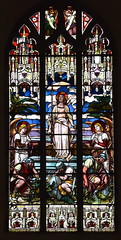
progressed. The east window, also by Ward & Hughes,
is earlier and a bit livelier. It depicts the
Resurrection, with Christ rising from the tomb above the
sleeping soldiers, the angels looking on. Mortlock
admired it for its colour and draughtsmanship, although
it does unfortunately look as if Christ is knocking on
the ceiling with his cross, perhaps shouting "Can
you keep the noise down please? We're trying to sleep
down here!"
As you might expect, the work of the highest quality here
is in the south aisle. There is a spectacular memorial to
Frederica Doughty, who died in 1843, on the west wall.
The date seems incredibly early for such confident,
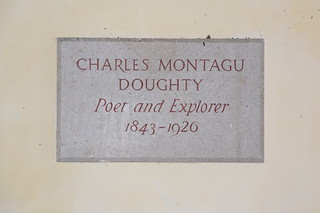
vibrant High Victorian work. Beside it is a simple
memorial to the explorer and poet Charles Doughty, author
of the 1888 work Travels in Arabia Deserta. As
Doughty's biographer on Wikipedia observes, it is
written in an extravagant and mannered style, largely
based on the King James Bible, but constantly surprising
with verbal turns and odd inventiveness. This book
was much admired by two remarkable writers, each very
different from the other: TE Lawrence wrote a gushing
introduction to the republication of 1922, and the author
Henry Green wrote an essay about the influence of
Doughty's work on him, most obviously in his novel Living.
Their joint patronage has helped ensure that Doughty's
work has gone in and out of print ever since.
Several display cases are devoted to this parish's links
with the city of Adelaide in Australia. Colonel William
Light, who came from Theberton, surveyed the site for the
city, and one of its suburbs is called Thebarton. The
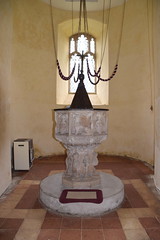
vestry door is kept open so you can see the Norman north
doorway, and the 15th Century font nearby is similar to
those at several neighbouring parishes.
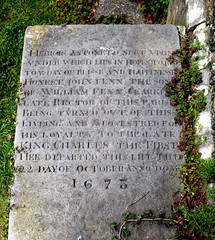
But my favourite thing of all is outside the south porch.
It is a table tomb against the wall, and commemorates
John Fenn, the Laudian Rector here in the early 17th
century, who was hounded out as a scandalous minister
(that is to say, a theological liberal) by the Puritans.
He was lucky to escape with his life, for the Rector at
Brandeston was found guilty of witchcraft, and hung.
Fenn survived the Commonwealth, and died here after the
Restoration of the Church of England. The inscription
reads: Here is a stone to sitt upon under which lies
in hopes to rise to y day of blisse and happinesse honest
John Fenn, the sonne of William Fenn, Clarke and late
Rector of this parish. Being turned out of this living
and sequestered for his loyalty to the late King Charles
the First hee departed this life the 22 day of October
anno domini 1678. This request for us to rest would
have been profoundly disapproved of by his puritan
persecutors. Rarely is it so easy to strike back at
religious fundamentalism, but here one can do so simply
by sitting down.
Simon Knott, May 2019
Follow these journeys as they happen at Last Of England
Twitter.
|
|
|