St Peter, Weston

www.suffolkchurches.co.uk - a journey through the churches of Suffolk
|
St Peter, Weston |
|
|
||
www.suffolkchurches.co.uk - a journey through the churches of Suffolk |
||


Follow these journeys as they happen at Last Of England Twitter.
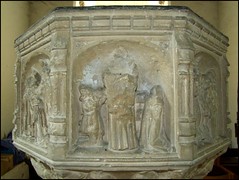
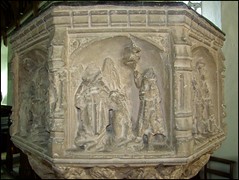
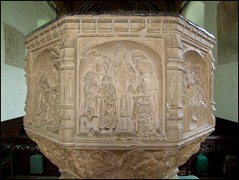
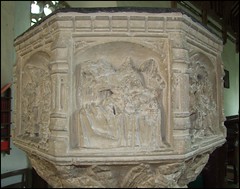
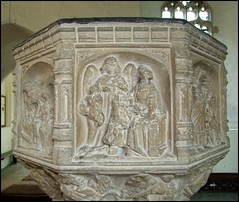
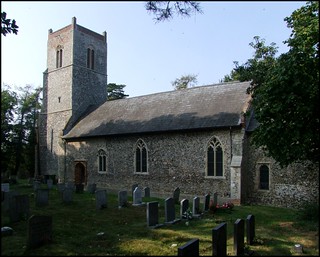
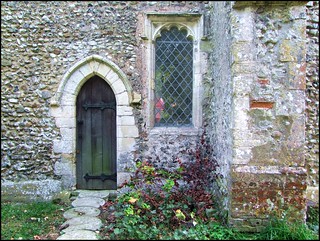
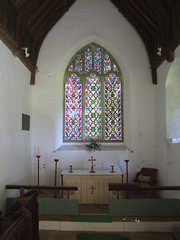
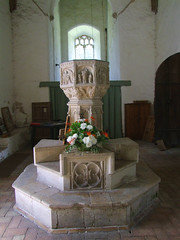
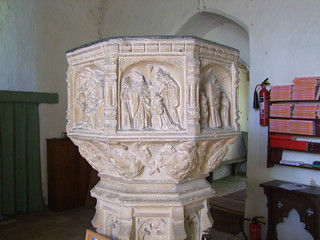
This is a blissfully serene church in a secluded tree-surrounded churchyard in the backroads of north-east Suffolk. It is small and architecturally undemonstrative, but it contains one of East Anglia's great medieval art treasures, as we will see. The chunky tower and long chancel are rather deceptive, for this is basically a single-cell Norman church which was enhanced in the late medieval period. William Garneys, rector here in the early 15th Century and clearly a man of some substance, left £16 in his 1425 will to pay for the tower to be built and for a thousand masses to be said for his soul by the friars in Norwich, Dunwich and Yarmouth. Wills of 1428 and 1438 also left money to the new tower, but by 1465 bequests were being made to internal furnishings, suggesting that the tower was complete. The south doorway was rebuilt in red brick in the 16th Century and must have been very grand despite the fact that it is barely a metre and a half tall. On the inside the doorway opens into a tall Norman archway. The door itself is the 16th Century original, but it is now blocked off internally. At the time of White's Directory in 1844 the roof of the church was thatched. There is no way of missing the star of the show as you step inside. Weston is blessed with one of the thirteen surviving Seven Sacrament fonts in Suffolk. None of the others in the county, even the one at Badingham, are in such a tiny church, and consequently it momentarily creates the illusion that the church was built around the font to house it. It sits on a very high Maltese cross which is probably the original, but appears to have been recut, as does the font shaft. A former rector here told me once that the height of the font and its narrowness makes baptising a baby in it a perilous experience. Although the panels are badly mutilated this font isn't in the terrible condition that Mortlock suggests, and most of the panels are easily decodable. The easterly facing one depicts Mass, and then anti-clockwise they are Confirmation as the north-east panel, Baptism to the north, so facing the main entrance and then the odd-panel-out, the Baptism of Christ, facing north-west. The most westerly panel is Matrimony, and then the sequence continues with Last Rites to the south-west, Confession facing the south doorway, and finally Ordination to the south-east.
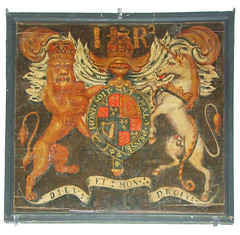
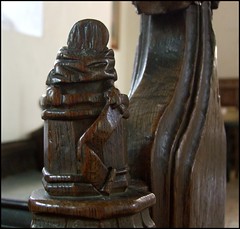
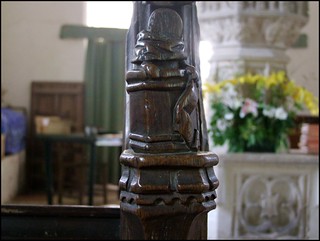
With the possible exception of the one now in the 19th Century church at Melton, the Weston font is probably the least known of the Suffolk series. And yet, this church has a number of other has many other fascinating details. The bench ends are probably by the same artist as the ones up the road at Redisham. At the east end on the south side is a bat-winged dragon, and the south side also features a now-headless cowled figure preaching from a pulpit. He was probably an ape, a comment on preaching friars, and he holds his text in a clawed hand. But it is the carvings on the north side that are the most memorable. What appears to be the back half of a lion balances a medieval cooking pot on his back. A similar carving survives in more complete form at Redisham, where it is revealed as a dragon, who is leaning back to lick out the pot. Mortlock suggests that it might illustrate the legend in the bestiary about a group of sailors shipwrecked on an island. They light a fire to cook food, whereupon the island awakes and shakes them off - it was a whale all the time. As Mortlock wryly observes, the medieval carver here had never seen a whale, but he knew very well what a dragon was. Also on this side is a stubby little post-mill, with a stairway leading up into it. Unsurprisingly, over the centuries it has lost its sails. When Pevsner came this way in the late 1950s he found this bench up in the chancel. The only bench end remaining of note up there now is one of a priest at a prayer desk, a bit like the one at Stowlangtoft. And not content with its remarkable font and bench ends, Weston also has some surviving fragments of wall paintings. These are on the south side, and show Christ's entry into Jerusalem, rather like the ones nearby at North Cove. it peeps above a late 16th or early 17th Century improving text. There are two more of these elsewhere in the church. What else? Weston is home to one of Suffolk's only three surviving James II royal arms. The decalogue opposite was probably made contemporarily, but appears crude in comparison. A roundel of continental glass nearby depicts Christ in the garden at Gethsemane. A sad memory of later times is the headstone in the north-west corner of the churchyard. It is to five Sarbutt children, who died within two weeks of each other in 1896. This is a church which deserves to be better known, and to receive more visitors. Just a quiet and remote spot in the outback of East Anglia and it doesn't feel like much happens here,, but as I have observed elsewhere the main destiny of our medieval churches is not to be contemporary worship spaces, but to be the soul in stone at the hearts of their communities, and as witnesses to larger truths, just by raising their heads above the rooftops and above the woods and fields. |
Simon Knott, January 2021





Follow these journeys as they happen at Last Of England Twitter.
Amazon commission helps cover the running costs of this site