| |
|
 |
|
Hamlets huddle and cluster
in the rolling landscape between Bury St
Edmunds and Haverhill, the occasional
church tower punctuating the skyline
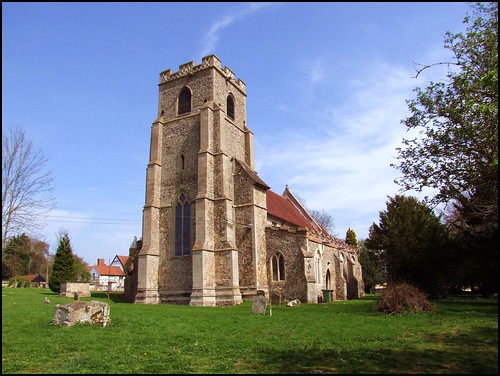
above the copses and hedgerows. All
Saints is a useful reminder that these
are the towers of parish churches,
not village churches. Coming
here on the main road, you might think
Wickhambrook to be a typically large west
Suffolk village, just about close enough
to Cambridge to provide it with
commuters, but Wickhambrook parish
contains a scattering of hamlets set
around a grid of lanes, and a mile or so
off from the high street you turn down a
winding lane, and come out in a street of
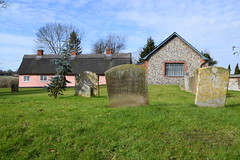
pretty cottages. Here is the church, and
the long pink line of a set of 17th
century almshouses provides a beautiful
western boundary to the walled graveyard.
|
I've
been here before a number of times, but it had
been a good ten years since my last visit and
coming back in 2018 I already knew, because I'd
been told, that the church is now kept locked.
There may be a good reason for this, as we will
see, although it is still not much of an excuse.
It is, however, very much against the trend in
East Anglia, where many churches I found locked
twenty years ago are now open daily.There was a
keyholder notice with no less than seven
keyholders, and a further two had been crossed
out. One key was next door at the rectory, which
was pleasing as it is more usual for ministers to
delegate the task of being keyholder to someone
who doesn't mind being disturbed by strangers. I
walked down the path to the rectory, but I could
see at once that the place was empty, and no one
was living there any more.
Luckily I'd taken a photo of the notice, and saw
there was another keyholder in the cottage across
the road. Unfortunately, the woman who opened the
door was surprised and not terribly pleased to
see me. "But I don't have a key!" she
said, "I've never had a key! I was shocked
to see my name on that notice! I've just
recovered from a major operation!" I made my
excuses and left, wondering why she hadn't
crossed her name off like two other
non-keyholders obviously had.
| At this point I decided that
instead of haring off on any more wild
goose chases or similar mixed metaphors,
I would ring the next nearest, about a
mile off. I explained that I'd rung just
to make sure he existed, and he seemed
happy with that. He was also very happy
to come and open up, and said he'd be
there in 5 minutes, but these were
Suffolk minutes, and it was almost half
an hour before he arrived. A part of me
wished I hadn't bothered, because I
already knew that All Saints is perhaps
one of the less interesting of the
churches in the area, but having rung him
I obviously didn't feel I could just head
off. And in any case, patience was its
own reward, for a wander around the
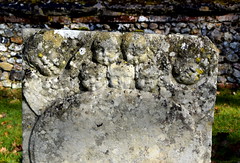
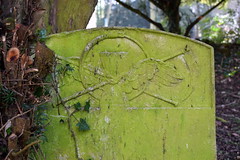
churchyard turned up some extraordinarily
good late 18th Century headstones,
including one with the heads of five
children flanked by two cherubs, and
another featuring a winged hourglass and
crossed scythes surrounded by a snake
biting its own tail, a symbol of
eternity. |
|
 |
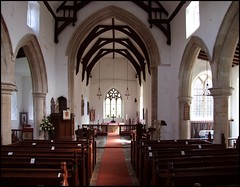
Even
these pleasing discoveries gave time for a fairly
lengthy examination of the building itself. All
Saints is a large, lovely church, of great age
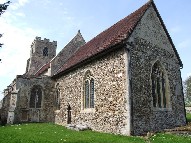
and dignity. The first impression is of the great
swathe of the 14th century aisles, with pretty
clerestories peeping above them. But there is
some evidence of Saxon work at the east end of
the aisle, and so this must have been the site of
the original church, the later chancel being
built beside it, and the great nave and south
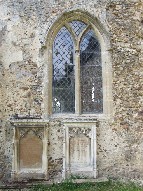
aisle extending westwards. If you go round to the
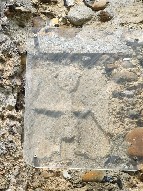
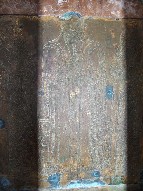
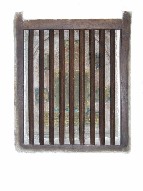
south side, you'll find a Norman carving reset
high up at the west end of the aisle wall, rather
unfortunately covered in perspex to protect it.
It depicts a man holding a sword and a shield.
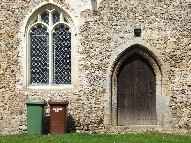
When the pleasant keyholder arrived he told me
that they keep the church locked now, because a
visitor the previous year had unbolted the south
door from the inside, and then come back at night
and stolen an 18th Century table, presumably to
sell in some New England antiques shop. I was
about to suggest that the obvious solution was
for the person whose job it was to lock up to
check all the other doors too before they left,
but it quickly became clear that the real reason
they keep the church locked is that there is now
no one left who is prepared to open and close the
place each day. Are you the churchwarden? I asked
him. I'm everything here now, was his startling
reply.
 |
|
Arthur Mee remembers the
forgotten 19th century romance Golden
Days by Edna Lyall, which is set in
Wickhambrook. The hero visits this
church, which he finds "plain enough
and bare enough to please a
puritan". There is certainly a sense
of space, and the size may account for
its bareness, although Lyall might have
known the church before its considerable
1860s reordering. In those days, the
pulpit stood at the west end, and the
seats faced west rather than east. This
was not unusual in puritan hotbeds, and
it attempted to break the link between
the eastwards view and Catholic
sacramentalism. The same was found
elsewhere in Suffolk at Bramford and
Little Bealings. Certainly, puritan
staunchness seems to have dispensed with
Catholic romanticism in this parish.
Peter Northeast records that a new Vicar,
arriving here fresh from the ferment of
Tractarian Oxford in the mid-19th
century, could not find a single person
in the parish who knew the dedication of
the church. |
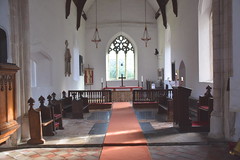
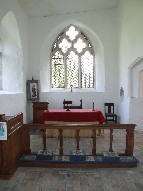
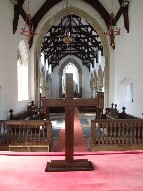
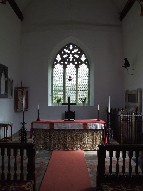
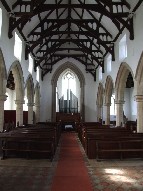
The
view eastwards is a remarkable one, with the
beautiful low east window, and a low arch
connecting north aisle chapel and chancel. The
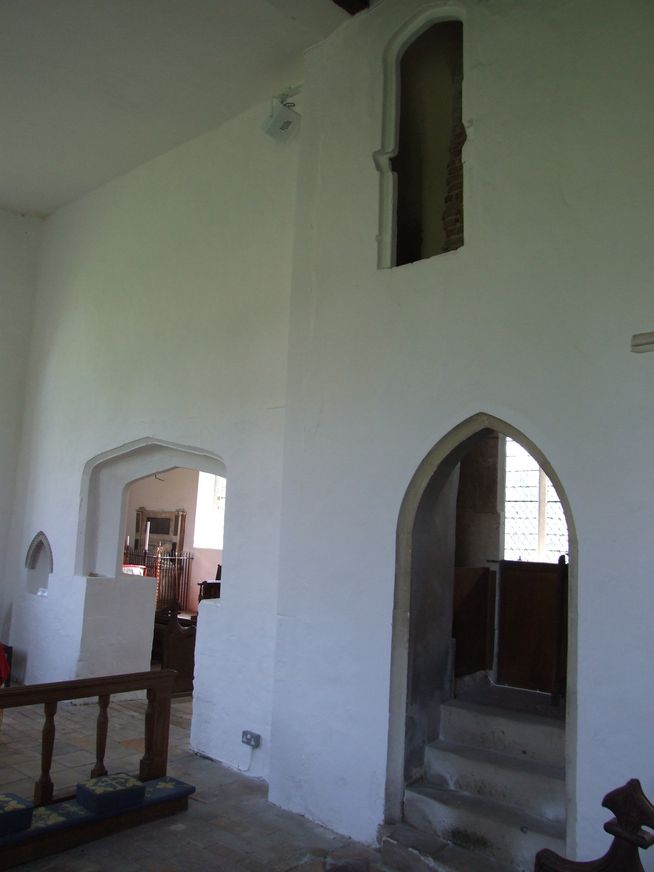
rood loft apparatus describes a winding path, and
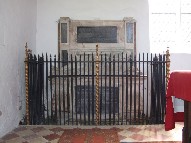
up in south side of the sanctuary there is a fine
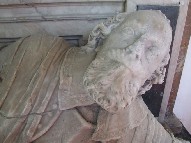
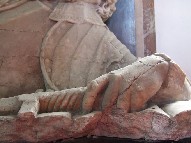
railed memorial to Thomas Higham. He lies
defiantly, sword in hand, as if ready to take you
on in mortal combat, something he is, in fact,
remembered for doing on more than one occasion.
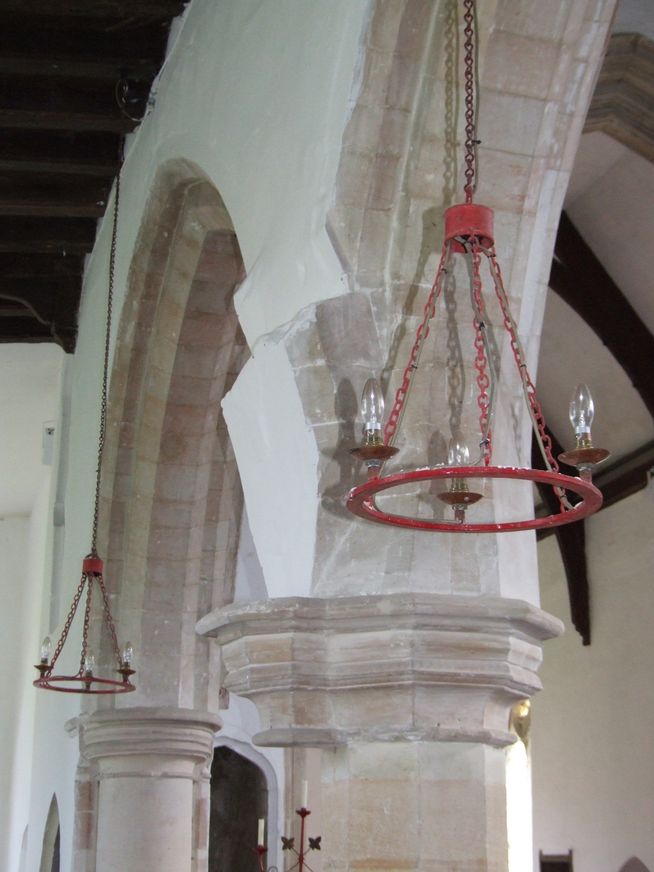
There are a couple of puzzles. About two thirds
of the way up the north aisle, on the north side
of the arcade, is the springing for an arch. It
seems complete incongruous, unless it is in fact
the north aisle which is the site of the original
church, and a chancel arch was intended here
before they decided to build the church bigger.
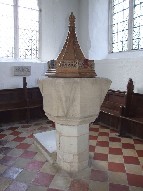
And the font bowl is a most unusual shape - I
think it must once have been square, and was cut
to its octagonal pattern, perhaps in the late
14th Century, to suit changing fashions.
The
font was one of my main reasons for wanting to go
inside again, for on 7th July 1833 it was the
place of baptism of Elijah Carter, probably the
most appalling of all my known ancestors. He was
one of my sixteen great-great-great-grandfathers,
and after moving to Ely in the 1860s he was
regularly charged, fined and imprisoned for
domestic violence.
It wasn't just his family
who suffered at his hands, for the Ely
newspapers describe his acts of drunken
destruction with monotonous regularity in
the 1870s. His periods of residence in
Cambridge prison increased in length, and
by the 1880s he had left the family home
altogether. The last trace I have of him
is of a period of imprisonment for
vagrancy in 1890, after he was found
begging with menace on the streets of the
city. He doesn't seem to be on the 1891
census, and so he probably died soon
afterwards, perhaps even in prison.
No doubt the family were glad to see him
go. Elijah's daughter Sarah married
Thomas Cross in Ely Cathedral in 1881,
and their eldest daughter would grow up
to be my dad's Grandma Sophie. She
married Arthur Page, who was killed at
Delville Wood in the Battle of the Somme
on 20th July 1916, twenty years before my
father was born. |
|
 |
|
|
|