| |
|
 |
|
Glemsford is a funny place
and no mistake, and I'm not only saying
that because I married into a Sudbury
family. Mention Glemsford to older
Sudbury people and they'll shake their
heads like my father-in-law does and
observe something along the lines of
'they're funny buggers in Glemsford'. In
the hothouse of industrial late medieval
Suffolk, Glemsford was an equal partner
with Melford and Sudbury, but it has
become something of a backwater over the
last half a millennium or so. There is
still a large factory down on the main
Melford to Clare road, and a feel in the
village itself that something industrial
happened here once, but otherwise not a
lot seems to be going on, and the little
that does happens slowly and quietly. Not
that there is anything wrong with that,
of course, and if Glemsford is not one of
the more attractive Suffolk villages it
still at least has its shop and its
school. And, of course, its
church, although perhaps the church is
not quite the centre of its community in
the way that many other Suffolk churches
are. Why do I say this? Well, so often in
a Suffolk village you can step into the
church in search of a sense of the
numinous and perhaps the genius loci,
often discovering that someone else has
had the same idea, but at Glemsford
there's a sign that says this church is open for
viewing on Tuesdays during the school
term during school hours. At all other
times please contact the churchwarden.
You'd think that they didn't
actually want you to go inside.
|
So I rang the churchwarden,
whose number I found after a search of the other
notices. As you've probably guessed, he was out. I
rang the rector. He's been there years and years
- I got the key from him on my previous visit
back in 1998. I thought I heard a faint sigh -
perhaps he was used to this happening. He made a
phone call and arranged for someone else to come
and open up. Then I remembered him telling me
fifteen years ago that the congregation was too
small to provide anyone to open and close the
church each day, neatly sidestepping the reason
why he didn't do this himself. Presumably, it
hasn't got much bigger in the years since.
While we
waited, we took a wander around the churchyard,
which is tight on the south side but opens out
widely to the north, the rolling hills beyond the
churchyard reminding me that the highest point in
Norfolk and Suffolk is just a few miles off. The
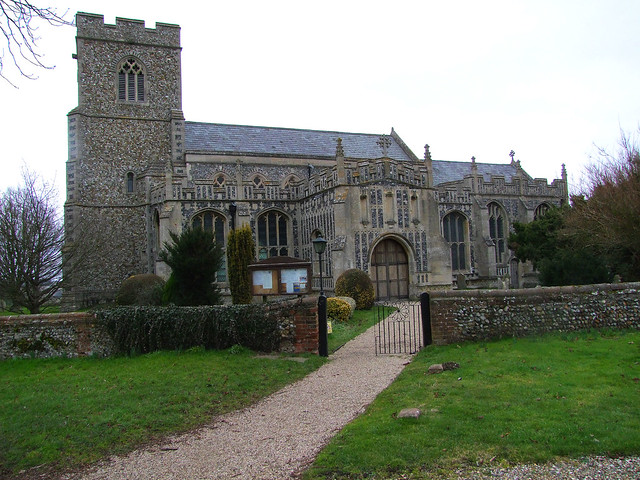
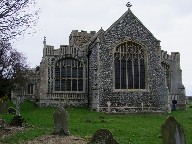
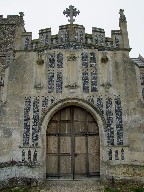
exterior is a curiosity in itself; the fabulous
porch, chancel and south aisle were obviously the
result of serious money on the eve of the
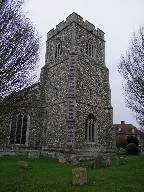
Reformation, but a dull-handed 19th Century
restoration gave us a characterless recladding of
the tower tower and clerestories. There is a feel
of what might once have been. There is a haunting
dedicatory inscription on the south side of the
chancel. The beginning of it has been erased by
iconoclasts, but obviously said PRAY FOR
THE SOULS OF. It then continues JOHN GOLDYNG
& JOAHN HYS WIFE THE FOUNDERS OF THIS CHAPEL
AND IYLAS (aisles). A further part has been
erased - possibly LORD HAVE MERCY?
| Having
exhausted the possibilities of
excitement, we waited in the wintry chill
for the key. The bloke, when he came, was
very friendly and cheerful - "I've
brought m'paper, you take your
time!" - and so I stepped
into All Saints for the first time in 15
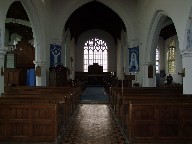
years. There's not a lot to see. The
inside is bright, attractive, overneat.
Interestingly, the arcades do
not match; one is higher than the other,
an indication that the aisles were built
as part of slightly different projects.
The roof above them dates from the 1870s,
as does that in the south aisle. But that
in the north aisle is the medieval
original, and very lovely. Probably, it
was completed as part of John and Joan
Golding's bequest in the early 16th
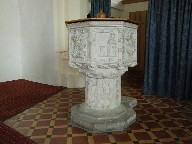
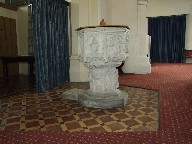
Century. There is a battered
old font
with a representation of Mary at a prayer
desk, presumably part of an Annunciation
scene. And the fat bull of St Luke is
rather jolly. But really, there's not
much evidence of this building's glorious
past. However, I'm still bound to ask how
an English church which was at one time
significant can now be kept locked. What
kind of an act of witness is that? We
said our farewells. It was with something
like relief that we headed back down from
the hills towards Melford and
civilisation.
|
|
 |
|
|
|